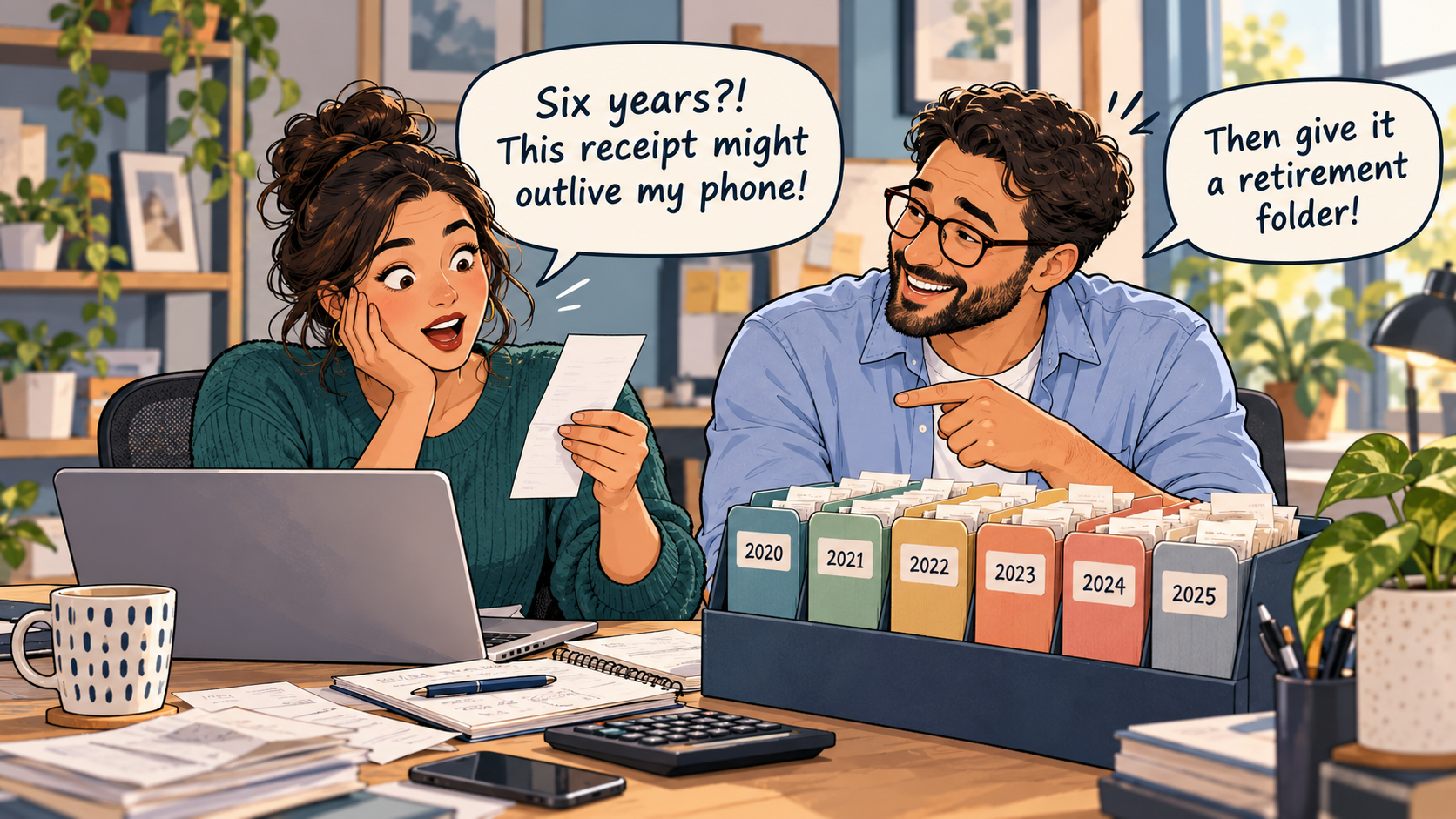
There's a particular kind of satisfaction that comes from cleaning out a drawer full of old receipts.
The faded coffee-shop slips. The crumpled parking receipts. The mysterious hardware-store purchase you can barely remember making.
Into the recycling bin they go. Right?
Not so fast.
If you run a business in Canada, some of those seemingly insignificant pieces of paper could be important financial records. And throwing them away too soon may leave you scrambling if the Canada Revenue Agency (CRA) asks you to support an expense or tax claim.
Fortunately, you don't have to keep every receipt forever. You just need to understand the rules, know which exceptions matter, and build a system that makes finding your records easy.
The Short Answer: Usually Six Years
The CRA's general rule is that businesses must keep required records and supporting documents for six years from the end of the last tax year to which they relate.
That includes receipts used to support business expenses, along with other financial records needed to establish income, deductions, and tax obligations.
But there's an important distinction: six years doesn't necessarily mean six years from the day you bought something.
The clock generally starts at the end of the relevant tax year.
For individuals, including most sole proprietors, the tax year is the calendar year. For corporations, it's generally the corporation's fiscal period.
And some records must be kept longer.
How Do You Calculate the Six-Year Retention Period?
Let's use a straightforward example.
Imagine you're a self-employed graphic designer who purchases a business printer on June 12, 2025.
If the receipt relates to your 2025 tax year, the general six-year retention period runs from December 31, 2025.
That brings the ordinary retention endpoint to December 31, 2031.
Here's how the calculation works for an individual whose records relate only to the indicated calendar year:
| Tax year | General retention through |
|---|---|
| 2023 | December 31, 2029 |
| 2024 | December 31, 2030 |
| 2025 | December 31, 2031 |
| 2026 | December 31, 2032 |
These are general examples, not automatic permission to destroy every document on those dates. A record may relate to later years or fall under an exception.
What if Your Business Is Incorporated?
A corporation generally counts the six years from the end of its relevant fiscal tax year, not necessarily December 31.
For example, if a corporation's fiscal year ends March 31, 2025, records relating solely to that fiscal year would ordinarily be retained through March 31, 2031, unless a longer period applies.
What if You File Your Tax Return Late?
The calculation changes.
The CRA says that when an income tax return is filed late, the related records must generally be kept for six years from the date the return is filed.
That means a late filing can extend how long you need to retain documents.
Which Business Receipts and Records Should You Keep?
A receipt is only one piece of the financial recordkeeping puzzle.
The CRA expects businesses to maintain enough information to substantiate their transactions and tax reporting.
Depending on your business, that may include:
Purchase receipts: Supplies, equipment, inventory, and other business purchases.
Supplier invoices: Bills showing what you bought, from whom, and for how much.
Sales invoices: Records of products or services sold to customers.
Bank and credit card statements: Supporting records of business payments and deposits.
Payment confirmations: Evidence that a transaction was completed.
Contracts and agreements: Documents explaining the terms of business transactions.
Mileage and vehicle records: Supporting information for business-use vehicle expenses.
Payroll records: Wage payments, deductions, and related employment information.
GST/HST records: Documents supporting tax collected, paid, and claimed.
Accounting records: Ledgers, journals, transaction reports, and financial statements.
You don't necessarily need every type of document for every purchase. You do need enough appropriate evidence to support what your business reported.
Is a Bank Statement Enough Without a Receipt?
Not always.
A bank statement may show that you paid $86.40 at a store, but it might not explain what you purchased or whether the expense was business-related.
A detailed receipt or invoice can provide information the statement doesn't contain.
For GST/HST input tax credits, additional documentary requirements may apply.
The safest approach is to retain the receipt or invoice alongside the corresponding payment record when appropriate.
Can You Keep Digital Receipts Instead of Paper?
Yes. Canadian businesses can maintain records electronically, provided they meet the CRA's applicable recordkeeping requirements.
That means a digital record should be readable, accessible, complete, and available when required.
A photo or scan of a paper receipt can be useful, particularly because thermal-paper receipts have a habit of fading long before their retention period ends.
However, there's a distinction between digitizing a paper receipt and retaining records originally created electronically.
Scanning Paper Receipts
The CRA permits paper records to be converted into electronic images when its imaging and recordkeeping requirements are met.
A properly maintained digital copy may allow you to dispose of the paper original, subject to applicable requirements and any other laws that require the original.
Simply snapping a blurry photograph and deleting the original isn't a reliable recordkeeping strategy.
Receipts and Records Created Electronically
If your accounting or transaction records were originally created electronically, printing them does not necessarily replace your obligation to retain the electronic information.
The CRA requires certain electronic records to remain in an electronically readable format throughout the applicable retention period.
What Makes a Good Digital Receipt?
Aim for a copy that clearly shows:
The seller or supplier
The transaction date
What was purchased
The amount paid
Any applicable taxes
Other information needed to support the transaction
Also make sure the file can actually be opened years later.
A perfectly organized folder of unreadable files won't help much during a review.
When Do You Need to Keep Records Longer Than Six Years?
This is where the familiar six-year rule needs a little more attention.
The CRA identifies several circumstances in which the usual retention period changes.
1. Records Connected to Long-Term Property
Documents concerning long-term acquisitions and disposals of property, share registries, or historical information affecting the sale, liquidation, or winding-up of a business may need to be retained indefinitely.
For example, if your business purchases a building, the purchase documents may remain important many years after the original transaction.
2. An Ongoing Objection or Appeal
If you file a tax objection or appeal, you may need to retain relevant records beyond the normal deadline.
The CRA requires necessary records to be kept until the applicable retention period and objection or appeal requirements have been satisfied.
3. The CRA Requires a Longer Period
The CRA may specifically require you to retain records for more than six years.
If that happens, follow the retention period communicated by the CRA.
4. Late or Outstanding Tax Returns
A late-filed income tax return can extend the retention period.
Outstanding GST/HST returns may also affect when the retention period begins for related records.
5. Your Business Closes
Closing a business doesn't automatically mean you can dispose of its records.
For a non-incorporated business that ends, the CRA generally requires records to be kept for six years from the end of the tax year in which the business ended.
Dissolved corporations have special retention rules, including a two-year period after dissolution for certain corporate records. Other legal requirements may still apply.
Can You Throw Away Receipts After Filing Your Taxes?
No—not simply because your return has been filed or assessed.
Filing a return and receiving a notice of assessment don't automatically end your recordkeeping obligations.
The CRA can request supporting documents after a return has been processed.
That's why receipts and other relevant records should remain accessible throughout their required retention periods.
The same principle applies if you file electronically. Uploading or submitting a tax return doesn't mean the CRA now holds every receipt supporting it.
What Happens If You Lose a Business Receipt?
First, don't panic.
Losing one receipt doesn't automatically mean an expense is invalid. But it can make the expense harder to substantiate.
If a receipt is missing, try to recover supporting evidence.
You might be able to obtain a duplicate from the supplier, download an invoice from an online account, retrieve an email confirmation, or locate the related payment record.
Keep any other relevant documents that help establish what was purchased and why it was a business expense.
The CRA determines whether the available records adequately support a claim. A bank transaction alone may not be sufficient.
The important thing is to avoid inventing receipts or treating an unsupported estimate as an original document.
How to Organize Business Receipts Without Creating a Paper Mountain
You don't need a complicated filing system.
You need one that you can maintain consistently.
Step 1: Capture Receipts Promptly
Save electronic receipts as soon as you receive them.
For paper receipts, scan or photograph them promptly using a method that preserves all relevant details.
Step 2: Organize by Year and Category
A simple digital folder structure might look like this:
Business Records → 2026 → Expenses → Office Supplies
You could also use categories such as travel, advertising, equipment, or professional services.
The specific system matters less than being able to find a record when you need it.
Step 3: Use Descriptive File Names
Compare these two file names:
IMG_2847.jpg
2026-01-15_Office-Supplies_86-40.jpg
Which one would you rather search for during a tax review?
Including a date, supplier or purpose, and amount can make records easier to identify.
Step 4: Match Receipts to Transactions
Whenever possible, connect receipts with the corresponding business expense entries.
This helps explain what a payment was for and reduces the chance of recording the same expense twice.
Step 5: Back Up Your Records
A single device or storage location is a risky place to keep years of financial records.
Maintain appropriate backups and periodically confirm that your files can still be accessed.
Step 6: Review Before Deleting
Before disposing of old records, check:
Which tax year they relate to
Whether the ordinary retention period has ended
Whether they relate to property or another long-term matter
Whether an objection, appeal, audit requirement, or other exception applies
Whether another law requires a longer retention period
Business Receipt Questions Worth Clearing Up
Do self-employed people in Canada have to keep receipts for six years?
Generally, yes. The CRA's ordinary six-year rule applies to relevant business records and supporting documents. The period usually starts at the end of the last tax year to which the records relate.
Can I throw away paper receipts after scanning them?
Yes, in many cases. The Canada Revenue Agency (CRA) generally accepts electronic copies of paper receipts, provided they are clear, complete, readable, and stored in accordance with its electronic recordkeeping requirements. Before disposing of original receipts, ensure your digital records meet those requirements.
Do I need to keep receipts for expenses I didn't claim?
You must keep records necessary to support your business transactions and tax obligations. Not every unrelated personal purchase needs to be retained as a business record.
Does the CRA accept photos of receipts?
Electronic images are acceptable when they meet the CRA's requirements for reliable, readable, and accessible records.
What if a receipt has faded?
Try to obtain a duplicate or other supporting documentation. This is one reason to digitize thermal-paper receipts promptly.
Do I need to keep receipts after closing my business?
Yes. Closing a business does not automatically end recordkeeping obligations. The required period depends on the type of business and the records involved.
Can I destroy business records before six years?
Generally, you need written permission from the CRA to destroy records earlier than the required period under legislation it administers. Other laws may impose separate requirements.
Before You Clear Out That Receipt Drawer
You don't have to become a professional archivist to manage your business receipts properly.
Start by remembering the general rule: six years from the end of the last tax year the records relate to, unless an exception requires something different.
Keep the records that support your business transactions. Make digital copies where appropriate. Back them up. And pay special attention to documents connected to long-term property, outstanding tax matters, or business closure.
Then, when you finally clean out that drawer, you can do it with confidence instead of crossing your fingers.
Sources & References
- Where to keep your records, for how long and how to request permission to destroy them early · Canada Revenue AgencyAccessed 2026-10-13
- Business records · Canada Revenue AgencyAccessed 2026-10-12
- Electronic Record Keeping (IC05-1) · Canada Revenue AgencyAccessed 2026-10-14
- Keeping records · Canada Revenue AgencyAccessed 2026-10-12