Working for yourself comes with freedom, flexibility, and a new responsibility: managing your own taxes.
Whether you're a freelancer, independent contractor, consultant, or small business owner, filing taxes can feel more complicated when there isn't an employer automatically deducting income tax from every payment.
The good news? Once you understand what income to report, which expenses you can claim, and how the filing process works, self-employment taxes become much easier to manage.
This guide walks you through the essentials of filing self-employment taxes in Canada, from organizing your records to submitting your return.
Who is considered self-employed in Canada?
You're generally self-employed when you earn income by operating a business or providing services on your own account rather than working as an employee.
You might be self-employed if you:
Work as a freelance writer, designer, photographer, or developer.
Provide consulting or professional services.
Operate a small business as a sole proprietor.
Earn income through qualifying gig or platform work.
Sell products or services through your own business.
You can also be employed and self-employed at the same time. For example, you might work a full-time job while earning additional income from freelance projects.
In that situation, you generally report both types of income on your personal tax return.
Important: Being paid without payroll deductions doesn't automatically make someone self-employed. The actual working relationship matters, and the Canada Revenue Agency (CRA) considers several factors when distinguishing employees from self-employed workers.
Do self-employed people file a different tax return?
If you operate as a sole proprietor, you generally report your business income on your personal income tax return, commonly called the T1 return.
You don't normally file a separate corporate income tax return simply because you're self-employed.
Instead, you calculate your business income and expenses using Form T2125, Statement of Business or Professional Activities. The resulting net business income or loss is then included in your personal tax return.
An incorporated business is different. Corporations generally have their own income tax filing obligations, including a T2 corporate return.
This guide focuses on individuals reporting self-employment income, particularly sole proprietors and independent contractors.
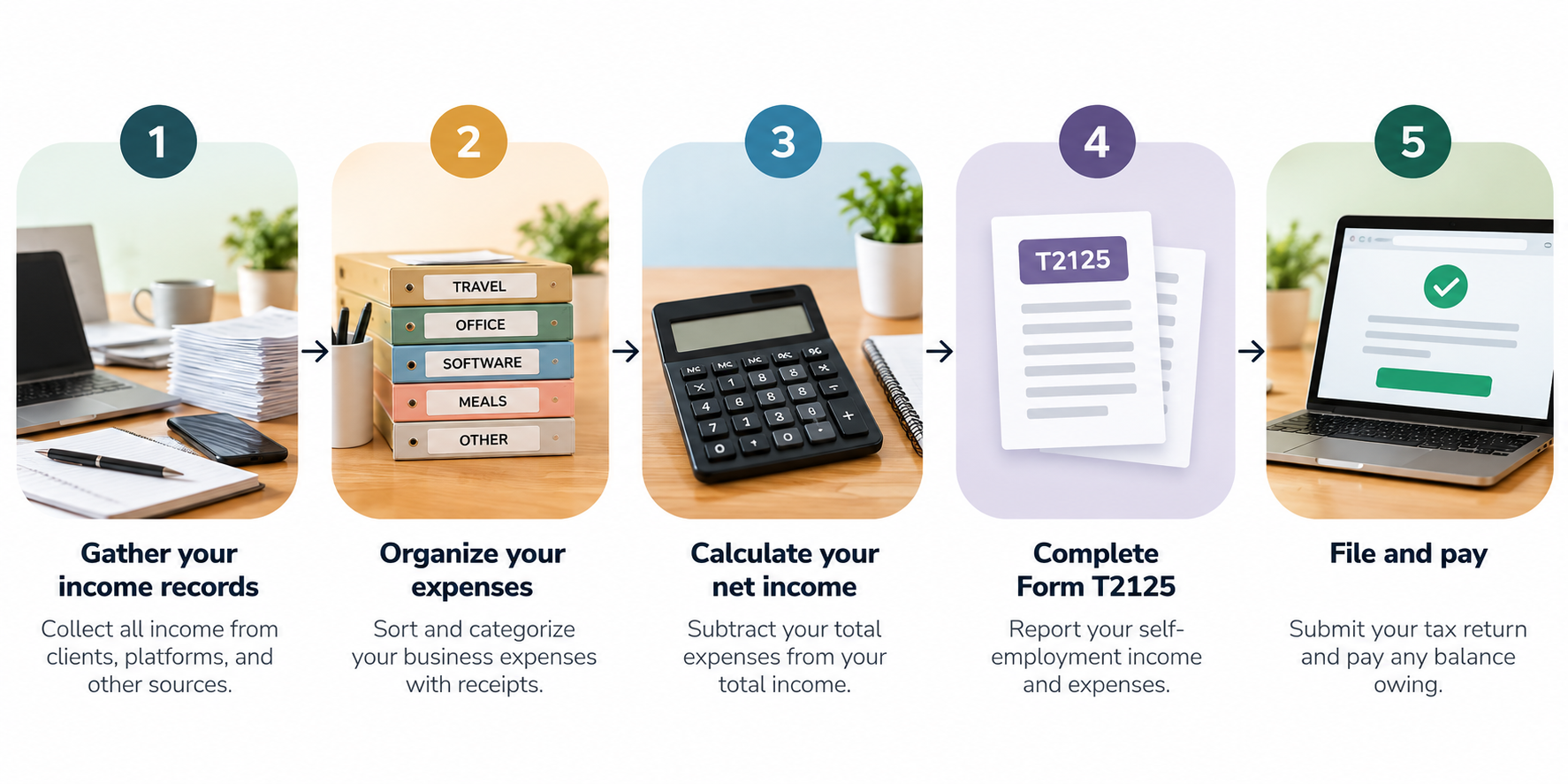
Step 1: Gather your income records
Before preparing your tax return, determine how much your business earned during the tax year.
Your income records might include:
Customer invoices and payment receipts
Sales reports from online platforms
Business bank statements
Payment processor statements
Cash sales records
Client contracts and transaction records
Relevant tax slips, such as T4A slips
Don't assume income is excluded just because you didn't receive a tax slip.
If you earned money from providing goods or services, it may still need to be reported.
What if a client hasn't paid your invoice?
The answer depends partly on the accounting method applicable to your business.
Most self-employed businesses report income using the accrual method. Under this method, income is generally recorded when earned, even if payment arrives later.
Certain businesses, including qualifying farming and fishing operations and some commission-based activities, may have different rules.
Example: Suppose you complete a consulting project in December and invoice your client for $2,000, but the client pays in January. Under accrual accounting, that $2,000 would generally belong to the year in which you earned it.
Keeping accurate records throughout the year makes these situations much easier to handle.
Step 2: Organize your business expenses
Business expenses can reduce the amount of income on which you pay tax, provided they qualify under CRA rules.
Generally, a deductible current expense must be reasonable and incurred to earn business income.
Common expense categories include:
| Expense category | Examples |
|---|---|
| Advertising | Website advertising and promotional materials |
| Office expenses | Eligible stationery and office supplies |
| Professional fees | Business-related accounting and legal services |
| Software and subscriptions | Qualifying business software costs |
| Telephone and internet | Business-use portion of eligible costs |
| Travel | Qualifying business travel expenses |
| Motor vehicle expenses | Eligible business-use vehicle costs |
| Business-use-of-home expenses | Qualifying home workspace costs |
Not every purchase is immediately deductible, and some categories have special restrictions.
For example, buying a computer may be treated differently from paying for a monthly software subscription. A computer may be a capital asset subject to capital cost allowance rules rather than a regular current expense.
If an expense is partly personal and partly business-related, you generally claim only the eligible business portion.
Example: If 60% of your qualifying phone expenses relate to business use, you would generally consider the business portion rather than claiming the entire bill.
Keep supporting documents and a reasonable basis for calculating any business-use percentages.
Step 3: Calculate your net business income
One of the most important figures on your return is your net business income.
In simplified terms:
Net business income = Business revenue − Eligible business expenses
Consider this example:
| Item | Amount |
|---|---|
| Business revenue | $55,000 |
| Advertising expenses | $1,500 |
| Software subscriptions | $1,200 |
| Office expenses | $800 |
| Professional fees | $1,000 |
| Other eligible current expenses | $3,500 |
| Total expenses | $8,000 |
| Net business income | $47,000 |
In this simplified example, your net business income is $47,000.
That doesn't mean you'll automatically pay tax on exactly $47,000. Your final taxable income and tax payable depend on other income, deductions, credits, CPP contributions, and your individual circumstances.
Also, some expenses require special calculations or adjustments, so your actual Form T2125 may be more detailed than this example.
Step 4: Complete Form T2125
Form T2125 is where many sole proprietors and self-employed professionals report their business activities.
It generally collects information about your business, including:
Business name and identifying information
Main business activity
Gross business or professional income
Cost of goods sold, where applicable
Operating expenses
Capital cost allowance, where applicable
Net business income or loss
If you operate more than one distinct business, you may need a separate Form T2125 for each business.
Do you have to complete the form manually?
Not necessarily.
Many NETFILE-certified tax software products guide you through questions about your business income and expenses and use your answers to complete the relevant tax forms.
If you work with an accountant or tax preparer, they may complete the form using the financial records you provide.
The key is making sure the information is complete and accurate, regardless of how you prepare the return.
Step 5: Understand income tax and CPP contributions
Self-employed individuals may have more than one type of tax-related obligation.
Personal income tax
Your net business income is generally included with your other taxable income and subject to applicable federal and provincial or territorial income tax rules.
Canada uses a progressive income tax system, meaning different portions of taxable income may be taxed at different rates.
The amount you owe depends on factors such as your total income, deductions, credits, and province or territory of residence.
Canada Pension Plan contributions
If you are self-employed outside Quebec, you may need to pay both the employee and employer portions of Canada Pension Plan (CPP) contributions on qualifying self-employment earnings.
This is an important difference from regular employment, where the employee and employer generally contribute separately.
CPP contributions are calculated under rules that include annual earnings thresholds and maximums. The applicable calculation may also take into account pensionable employment income.
In Quebec, the Quebec Pension Plan (QPP) generally applies instead.
Employment Insurance
Self-employed individuals don't automatically receive the same Employment Insurance coverage as employees.
Eligible self-employed people can voluntarily register for certain EI special benefits, subject to program requirements. This is separate from the ordinary process of reporting self-employment income.
Practical tip: When setting money aside for taxes, remember that income tax may not be your only obligation. CPP or QPP contributions can also affect how much you need to save.
Step 6: Check whether GST/HST applies to your business
Income tax and GST/HST are separate obligations.
You may need to register for and collect GST/HST if your business exceeds the applicable small-supplier threshold, generally $30,000 in taxable worldwide revenues over the relevant period for most businesses.
The threshold is based on revenue, not profit, and the timing rules matter.
Some businesses must register regardless of that threshold, while certain supplies are exempt or zero-rated.
If you're registered for GST/HST, you may need to file GST/HST returns separately from your personal income tax return.
This is why it's important not to confuse:
Income tax: Tax calculated using your taxable income.
GST/HST: Sales tax collected and remitted under applicable rules.
Depending on your province and business activities, provincial sales tax or Quebec sales tax obligations may also apply.
Step 7: Know your filing and payment deadlines
One of the most common mistakes self-employed Canadians make is assuming the filing deadline and payment deadline are the same.
They often aren't.
For the 2025 tax year, the CRA's general deadlines were:
| Requirement | Deadline |
|---|---|
| File a 2025 self-employed personal income tax return | June 15, 2026 |
| Pay a 2025 personal income tax balance owing | April 30, 2026 |
The June filing deadline generally also applies to a spouse or common-law partner of a self-employed person, subject to the applicable rules. Special circumstances, including certain tax shelter investments, can change the deadline.
The important distinction: Having extra time to file doesn't normally give you extra time to pay.
If you owe tax and miss the payment deadline, interest can apply even when you file by the self-employed filing deadline.
For future tax years, confirm the exact dates on the CRA website, including any adjustments for weekends or recognized holidays.
Step 8: File your tax return
Once you've calculated your business income and expenses, you can prepare your personal income tax return.
Common filing options include:
NETFILE-certified tax software: Prepare and electronically submit your return using eligible software.
A tax professional: Have an accountant or qualified tax preparer prepare and submit your return through the appropriate filing system.
Paper filing: Complete the required forms and mail your return, where applicable.
Before submitting, review your business income, expense amounts, personal information, and any additional employment or investment income.
After filing, keep your confirmation and review your Notice of Assessment when the CRA processes your return.
Your Notice of Assessment summarizes the CRA's assessment and may show a balance owing, refund, or other relevant information.
Step 9: Pay any balance owing
If you owe tax, the CRA offers several payment methods, including online banking and other approved options.
Use the appropriate payment reference and confirm that you're paying the correct account.
If you can't pay the full amount immediately, don't ignore the balance. You may be able to discuss a payment arrangement with the CRA, although interest can continue to apply.
Filing your return and dealing with the amount owing are two separate responsibilities.
Step 10: Prepare for next year's taxes now
The easiest tax return is usually the one you've been preparing for all year.
Instead of waiting until tax season, establish a few consistent habits.
Keep business and personal transactions organized
A dedicated business account can make it easier to identify business income and expenses, even where a separate account isn't legally required.
Record transactions regularly
Update your income and expense records throughout the year. Waiting several months increases the likelihood of missing information.
Save receipts and supporting documents
Keep digital or paper records that support your claims. The CRA generally requires business records to be retained for at least six years from the end of the last tax year they relate to, although exceptions apply.
Set aside money for taxes
Consider reserving a portion of business income for future tax obligations. The appropriate amount depends on your circumstances, so avoid relying on a universal percentage.
Check whether tax instalments are required
Some individuals must make income tax instalment payments during the year rather than paying everything when filing.
For many individuals, the regular instalment dates are March 15, June 15, September 15, and December 15, subject to the applicable rules.
Not everyone is required to pay instalments, so check your situation and any CRA instalment reminders.
Common self-employment tax mistakes to avoid
Even experienced business owners can make filing mistakes. Watch for these common problems.
Forgetting smaller sources of income. Income from occasional projects, digital platforms, and cash payments may still be reportable.
Claiming personal expenses as business expenses. Only eligible business-related amounts should be deducted.
Confusing revenue with profit. Revenue is what the business earns before expenses; profit is what remains after applicable expenses.
Assuming every business purchase is immediately deductible. Capital purchases and certain restricted expenses may require special treatment.
Missing the tax payment deadline. The self-employed filing extension doesn't generally extend the deadline for paying a balance owing.
Failing to maintain supporting records. Accurate documentation is essential if the CRA asks you to substantiate reported amounts.
When should you hire an accountant?
Many self-employed Canadians can prepare relatively straightforward returns using tax software.
However, professional advice may be especially valuable when you have complicated deductions, substantial capital purchases, employees, multiple businesses, cross-border transactions, or uncertainty about GST/HST obligations.
An accountant can also help with business structure decisions, tax planning, and understanding how different income sources affect your return.
The goal isn't necessarily to outsource every financial task. It's to know when specialized guidance can save time, reduce mistakes, or help you make better decisions.
Frequently asked questions
Do I have to report freelance income if I earned only a small amount?
Generally, business income must be reported even if the amount is relatively small. Whether you ultimately owe tax depends on your full circumstances. Don't confuse the GST/HST small-supplier threshold with an income tax reporting exemption.
Can I claim business expenses without receipts?
You need adequate records to support your expense claims. A bank statement alone may not always establish what was purchased or whether it was business-related. Keep invoices, receipts, and other supporting documentation wherever possible.
What if I have a full-time job and freelance on the side?
You generally report your employment income and your net self-employment income on the same personal income tax return. Your employment income and payroll deductions can affect the overall calculation.
Do I need a business number to file self-employment taxes?
Not every sole proprietor needs a CRA business number solely to report self-employment income. Registration requirements depend on your business activities and applicable program accounts, such as GST/HST or payroll.
What happens if my business operates at a loss?
A genuine business loss may affect your personal tax calculation, subject to the applicable rules. Losses, especially recurring losses or those involving personal activities, can require closer review. Seek professional guidance when the treatment is uncertain.
Final thoughts
Filing self-employment taxes in Canada doesn't have to be overwhelming.
Start by understanding your reporting obligations, keeping reliable records, identifying eligible expenses, and learning how Form T2125 fits into your personal tax return.
The more organized your finances are throughout the year, the less stressful tax season becomes.
And while tax software or an accountant can help you complete the return, good financial habits are what make the entire process easier.
Make tax preparation less stressful. Keep your receipts, expenses, and financial records organized throughout the year so the information you need is easier to find when it's time to file.