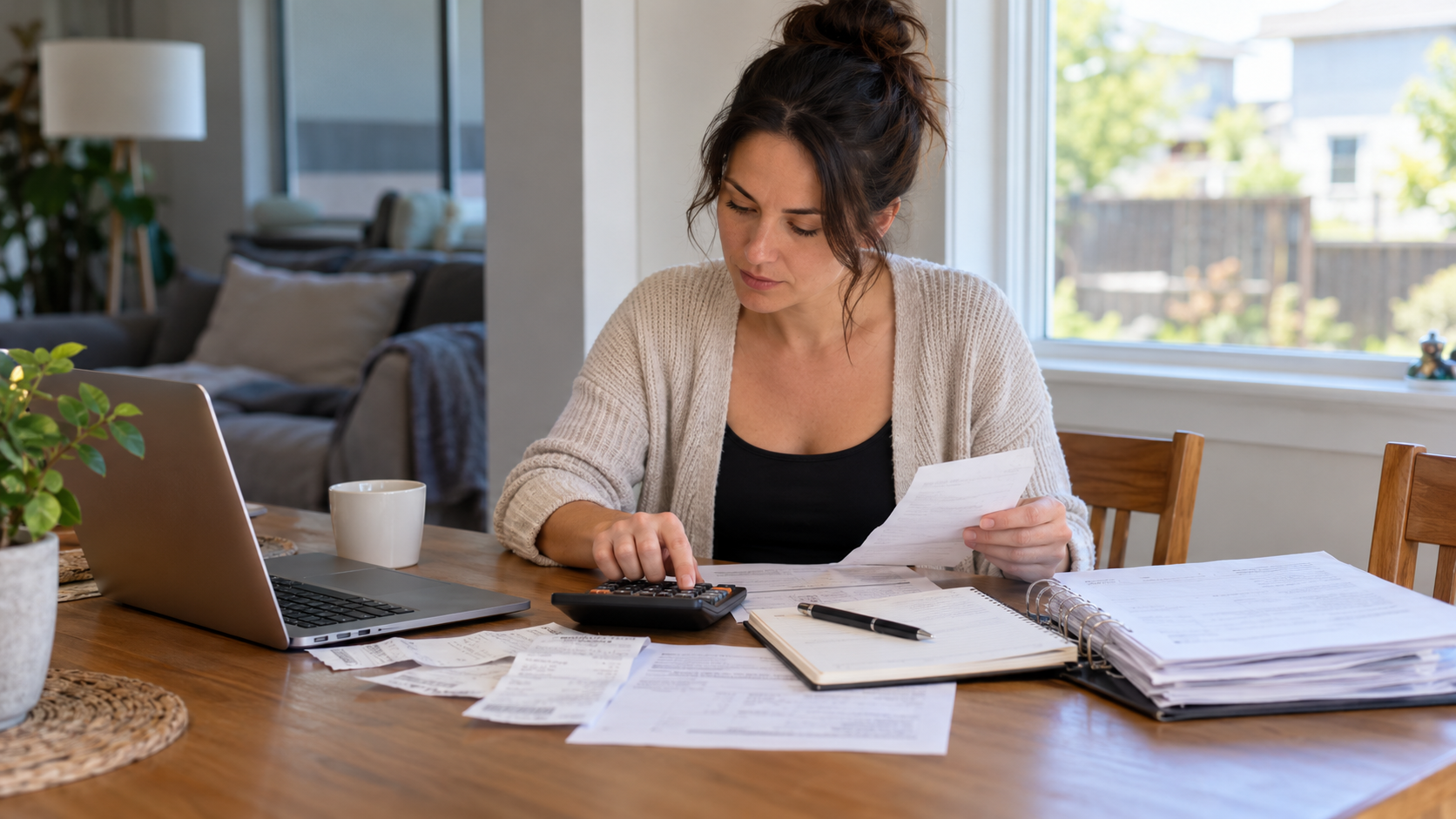
You finally get paid for a big project. The money lands in your account, and for a moment, it feels like every dollar belongs to you. Then tax season comes around, and you discover that some of that money should have been set aside months ago.
Unlike employees who receive paycheques with income tax and other deductions already taken out, sole proprietors generally have to manage those obligations themselves. It's a responsibility that can catch new business owners off guard, particularly when they've spent most of the year treating customer payments as money they can freely spend.
The good news is that sole proprietorship taxes in Canada become much easier to understand once you know what you're responsible for. You need to understand how your business profit is taxed, which expenses you can deduct, whether you must collect GST/HST, and how much you may owe toward the Canada Pension Plan (CPP). With those fundamentals in place, you can make better financial decisions throughout the year instead of scrambling when tax season arrives.
How Is a Sole Proprietorship Taxed in Canada?
A sole proprietorship is a business owned by one individual. Unlike a corporation, it isn't a separate legal entity from its owner. This means your business income is generally taxed as part of your personal income, rather than through a separate corporate income tax return.
Suppose you're a freelance graphic designer in Alberta earning $45,000 from your design business and another $30,000 from a part-time job. When you prepare your personal income tax return, both sources of income are considered, along with any applicable business deductions, personal deductions, and tax credits. You don't file a separate corporate income tax return simply because you've registered a business name or started working for yourself.
Where Do You Report Your Business Income?
Most sole proprietors report their business income and expenses using Form T2125 — Statement of Business or Professional Activities. This form helps you calculate your gross business income, eligible expenses, and net business income or loss. The resulting amount is then included in your personal T1 income tax return.
If you operate multiple distinct businesses, you generally need a separate Form T2125 for each business or professional activity. The important distinction is that your business records provide the financial information, while your personal tax return brings everything together to determine your overall income tax position.
For a step-by-step explanation of preparing your return, see How to File Self-Employment Taxes in Canada: A Step-by-Step Guide.
Do You Pay Taxes on Revenue or Profit?
One of the first things every sole proprietor should understand is the difference between revenue and profit. Your revenue is the money your business earns from providing goods or services, while your profit is what remains after deducting eligible business expenses. For income tax purposes, you generally pay tax on your net business income, not simply on the total amount customers pay you.
This distinction can make a substantial difference to your tax calculation. A business earning $100,000 in annual revenue does not necessarily have $100,000 in taxable business income, particularly if it incurs significant costs to operate.
Meet Sarah, a Self-Employed Consultant
Sarah operates a small consulting business in Canada. During the year, she earns $68,000 from clients but also spends money on advertising, software subscriptions, office supplies, professional services, and other eligible business expenses. By the end of the year, her financial records show the following:
| Business finances | Amount (CAD) |
|---|---|
| Total business revenue | $68,000 |
| Eligible business expenses | $18,000 |
| Net business income | $50,000 |
Her basic profit calculation is:
$68,000 − $18,000 = $50,000
Sarah's net business income is $50,000 before any further applicable tax adjustments. This is the amount generally included in her personal income tax calculation, rather than the full $68,000 in revenue.
That doesn't mean Sarah owes $50,000 in taxes, of course. A tax deduction reduces the income used to calculate her taxes; it doesn't reduce her tax bill dollar for dollar. The actual amount she owes will depend on her total income, province or territory, applicable deductions, tax credits, and other circumstances.
What If You Transfer Money to Your Personal Account?
Now suppose Sarah transfers $20,000 from her business account into her personal account during the year. She might assume that because she only paid herself $20,000, that's the amount she needs to report as income. Unfortunately, sole proprietorship taxes don't work that way.
The transfer is generally considered an owner's draw, not a deductible business expense or a separate taxable salary payment. Sarah's business profit is still calculated using her revenue and eligible business expenses, regardless of how much she chooses to withdraw for personal use. Similarly, keeping her earnings in the business account doesn't automatically defer the personal income tax she owes on those profits.
How Much Income Tax Does a Sole Proprietor Pay?
There isn't a single income tax rate that applies to every Canadian sole proprietor. Canada uses a progressive income tax system, which means different portions of your taxable income are taxed at different rates. The amount you ultimately owe depends on your overall financial circumstances, not just the profit shown in your business records.
Your income tax calculation takes several factors into account:
Federal income tax brackets
Provincial or territorial income tax brackets
Your total taxable income
Eligible deductions and tax credits
Income tax already withheld from other earnings
Federal and Provincial Taxes Both Matter
Someone operating a sole proprietorship in Alberta may have a different tax bill from someone earning the same business income in Ontario, British Columbia, or Quebec. Provincial and territorial income tax rates vary, and so do certain available credits and deductions.
Other sources of income can also make a difference. Consider two consultants who each earn $50,000 in business profit, but one also earns $70,000 from a regular job. Their tax calculations won't necessarily be the same because the second consultant has additional taxable income that may push portions of their earnings into higher tax brackets.
This is why blanket statements such as "sole proprietors pay 20% income tax" can be misleading. Your effective income tax rate depends on your personal situation, and the percentage that makes sense for one business owner may not be appropriate for another.
Do You Pay Tax When a Client Hasn't Paid You Yet?
In some circumstances, yes. Most Canadian sole proprietors are required to use the accrual method of accounting, which generally means reporting income when it's earned, even if payment hasn't arrived. Eligible expenses are also generally recognized when incurred, rather than necessarily when they're paid.
Certain businesses, including farming, fishing, and qualifying self-employed commission activities, may use the cash method instead. However, for a typical consultant or freelance service provider, an unpaid invoice can affect cash flow without necessarily changing when the income must be reported.
This is an important reason to maintain accurate records of both invoices and payments. Money you've earned, money you've collected, and money that's available to spend are not always the same thing.
CPP Contributions: The Tax-Related Cost Many New Owners Forget
Income tax isn't the only amount you may owe as a sole proprietor. If you're self-employed in Canada, you may also be required to contribute to the Canada Pension Plan (CPP), and this can be one of the more surprising expenses for someone who has previously worked only as an employee.
When you work for an employer, part of your CPP contribution is deducted from your paycheque, and your employer contributes an additional amount. When you're self-employed, you're generally responsible for both the employee and employer portions. As a result, the total contribution can be considerably higher than the amount you were accustomed to seeing deducted from an employee paycheque.
How Much CPP Does a Sole Proprietor Pay in 2026?
For 2026, the following rates and limits apply to qualifying CPP earnings outside Quebec:
| CPP component | 2026 amount |
|---|---|
| Basic annual exemption | $3,500 |
| Maximum earnings for first-tier CPP | $74,600 |
| Self-employed first-tier CPP rate | 11.9% |
| Maximum first-tier contribution | $8,460.90 |
| Additional CPP earnings ceiling | $85,000 |
| Self-employed additional CPP rate (CPP2) | 8% |
| Maximum CPP2 contribution | $832 |
The combined self-employed contribution rate of 11.9% applies to eligible earnings above the basic exemption and up to the first earnings ceiling. A second contribution, known as CPP2, applies to eligible earnings between $74,600 and $85,000 in 2026.
These rates reflect both the employee and employer portions that a self-employed person may be required to pay. The exact calculation can be affected by other circumstances, including employment income and CPP contributions already made during the year.
Calculating Sarah's CPP Contributions
Let's return to Sarah, our self-employed consultant whose business earned $50,000 in net income. To keep the calculation straightforward, we'll assume she's between 18 and 69 years old, lives outside Quebec, has no employment income or other CPP contributions, and has $50,000 in earnings that are fully eligible for CPP purposes. We'll also assume no special adjustments apply.
The first step is to subtract the annual basic exemption from her eligible self-employment earnings:
$50,000 − $3,500 = $46,500
Next, we apply the combined self-employed CPP contribution rate of 11.9%:
$46,500 × 11.9% = $5,533.50
Sarah's estimated CPP contribution for 2026 is therefore $5,533.50.
| Calculation | Amount |
|---|---|
| Net self-employment income | $50,000 |
| Basic CPP exemption | −$3,500 |
| Contributory earnings | $46,500 |
| Self-employed CPP rate | 11.9% |
| Estimated CPP contribution | $5,533.50 |
This amount is separate from Sarah's federal and provincial income tax obligations. She doesn't owe CPP2 because her earnings fall below the first 2026 CPP earnings ceiling. Her CPP contributions may also give rise to deductions and tax credits under the applicable income tax rules.
The important lesson is that looking only at income tax can underestimate the amount a sole proprietor needs to set aside. Sarah could have several thousand dollars in CPP contributions to account for before even considering her personal income tax bill.
What If You Also Have a Regular Job?
If you earn employment income while operating a sole proprietorship, the CPP contributions already deducted through your employment can affect how much additional CPP you owe. You shouldn't automatically apply the full self-employed contribution calculation without considering those existing contributions and the relevant annual earnings limits.
What If You Live in Quebec?
Quebec operates the Quebec Pension Plan (QPP), rather than CPP, for work covered by Quebec's pension system. QPP has its own contribution rates and rules, and self-employed Quebec residents may also have obligations under other provincial programs, including the Quebec Parental Insurance Plan (QPIP).
Do Sole Proprietors Pay Employment Insurance?
Self-employed Canadians generally don't contribute automatically to Employment Insurance (EI) on their self-employment earnings. However, eligible individuals can voluntarily register for EI special benefits, which provide support during certain periods when they cannot work or must step away from their business.
Depending on the circumstances, available benefits may include maternity, parental, sickness, compassionate care, and family caregiver benefits. Participation is subject to registration and eligibility requirements, and you generally need to have an active agreement for at least 12 months before receiving special benefits.
It's worth understanding exactly what this coverage does and doesn't provide. Registering for EI special benefits as a self-employed person does not entitle you to ordinary unemployment benefits simply because business slows down or you lose a customer.
Do You Need to Register for GST/HST?
Possibly. GST/HST is separate from personal income tax, and the rules determining whether you need to register are based largely on revenue from taxable supplies rather than business profit.
For most Canadian businesses, the key small-supplier threshold is $30,000 in revenue from taxable supplies. That is not the same as $30,000 in profit, nor is it an automatic exemption from personal income tax.
The CRA generally requires GST/HST registration when worldwide revenue from taxable supplies exceeds $30,000 in a single calendar quarter or over four consecutive calendar quarters. How and when you cross that threshold matters because it affects when you must register and begin charging the applicable tax.
The calculation generally includes zero-rated supplies, as well as relevant taxable revenue from all businesses you operate and from associated persons where the rules require it. Certain businesses and types of supplies are subject to exceptions.
What Happens If You Exceed $30,000 in One Quarter?
Suppose you operate a consulting business and generate $34,000 in taxable sales during a single calendar quarter. In this situation, you've exceeded the threshold within that quarter, and the CRA generally requires you to begin charging GST/HST on the supply that caused you to exceed $30,000. You must also register within the required period.
This means you cannot necessarily wait until the next calendar year to deal with GST/HST. A business that grows quickly may trigger the registration requirement much earlier than its owner expected.
What If You Cross $30,000 Over Several Quarters?
The rules are different when your taxable revenue gradually exceeds $30,000 over four consecutive calendar quarters, without exceeding that amount in any single quarter. In that case, you generally stop being a small supplier at the end of the month following the quarter in which you crossed the threshold.
You must then register and begin charging GST/HST according to the applicable effective-date rules. This distinction is worth paying attention to because crossing the threshold in a single quarter can trigger an earlier obligation than crossing it gradually over several quarters.
What If Your Revenue Is Below $30,000?
If your business remains below the applicable small-supplier threshold, you're generally not required to register for GST/HST, although exceptions exist. You may still choose to register voluntarily if you're eligible.
Voluntary registration can allow you to claim eligible input tax credits for GST/HST paid on business purchases, which can be beneficial for businesses that incur significant taxable expenses. However, registration also brings responsibilities, including charging the applicable tax on taxable supplies, maintaining records, filing returns, and remitting amounts owing.
Before registering voluntarily, consider whether the potential benefits outweigh the additional administrative work involved.
Does GST/HST Count as Business Income?
GST/HST collected from customers shouldn't be treated as ordinary business profit. When you collect sales tax, you're generally collecting an amount that must be accounted for separately and may need to be remitted to the government.
Consider a registered business in a situation where 5% GST applies to a taxable consulting service:
| Invoice item | Amount |
|---|---|
| Consulting service | $1,000 |
| GST at 5% | $50 |
| Customer pays | $1,050 |
Although the customer pays $1,050, the business hasn't earned $1,050 in revenue for income tax purposes. The $50 in GST is accounted for separately and may need to be remitted to the CRA after eligible input tax credits and other adjustments.
The applicable sales tax rate depends on the place of supply and the relevant rules. Some supplies are zero-rated or exempt, while businesses operating in Quebec must also consider QST requirements. Provincial sales tax obligations may apply in other provinces as well.
Which Business Expenses Can You Deduct?
One of the advantages of operating a business is that many reasonable expenses incurred to earn business income may be deducted when calculating your taxable business profit. However, not every purchase qualifies, and the CRA distinguishes between personal expenses, eligible operating costs, and capital expenditures.
The following table outlines some common expenses that Canadian sole proprietors may encounter:
| Expense | General tax treatment |
|---|---|
| Advertising and marketing | Eligible business promotional costs may be deductible |
| Office supplies | Reasonable everyday business supplies may be deductible |
| Business software | Eligible software subscriptions and service costs may be deductible |
| Telephone and internet | Business-use portion may be deductible |
| Accounting and legal fees | Eligible professional fees related to the business may be deductible |
| Business insurance | Qualifying commercial insurance premiums may be deductible |
| Vehicle expenses | Eligible business-use portion may be deducted |
| Business meals and entertainment | Generally subject to a 50% deduction limit, with exceptions |
| Home office expenses | May qualify if CRA workspace conditions are met |
| Equipment and capital assets | May require capital cost allowance or another applicable treatment |
Remember that a deduction is not the same as a refund. If you claim $1,000 in eligible business expenses, that doesn't mean the CRA will send you $1,000. Instead, the deduction generally reduces the amount of business income used to calculate your taxes, with the actual savings depending on your circumstances.
What About Expenses You Use for Both Business and Personal Purposes?
For many sole proprietors, personal and business expenses overlap. You might use the same mobile phone to communicate with clients and family members, work from your personal internet connection, or drive your own vehicle to business appointments.
When an expense serves both personal and business purposes, you generally need to identify the portion reasonably attributable to earning business income. You cannot automatically deduct the entire cost simply because the item is sometimes used for work.
Suppose your annual phone bill is $1,200 and your records support a business-use percentage of 60%. Your potentially deductible business portion would be:
$1,200 × 60% = $720
Assuming the expense qualifies and no other adjustments apply, you may be able to deduct $720 rather than the full $1,200. The same principle applies to many other shared expenses, although the appropriate calculation method can vary.
Can You Deduct Vehicle Expenses?
If you use your vehicle to earn business income, you may be eligible to deduct a portion of certain costs, including fuel, insurance, maintenance, repairs, licence fees, and qualifying leasing or financing expenses. Capital cost allowance may also apply if you own a qualifying vehicle.
However, vehicle expenses can be more complicated when you use the same car for both personal and business trips. In those circumstances, you generally need to calculate the eligible business-use percentage using appropriate records, including mileage information.
For a more detailed explanation, see How to Claim Vehicle Expenses for Business Use in Canada.
Can You Deduct Home Office Expenses?
Potentially. The CRA generally allows qualifying business-use-of-home expenses when your workspace is your principal place of business, or when you use the space exclusively to earn business income and regularly and continuously meet clients, customers, or patients there.
Depending on your circumstances, eligible expenses may include a reasonable business-use portion of heating, electricity, home insurance, rent, and certain other household costs. The treatment can differ depending on whether you own or rent your home, and whether the space is used exclusively for business or shared with personal activities.
For example, if you use a room for business during working hours but your family also uses it outside those hours, your calculation may need to consider both the proportion of floor space occupied and the amount of time the room is used for business.
There's also an important restriction: business-use-of-home expenses generally cannot be used to create or increase a business loss. Amounts that cannot be deducted because of this restriction may be carried forward, subject to the applicable rules.
Can You Deduct the Full Cost of Equipment?
Not necessarily. Suppose you purchase a new laptop that you'll use in your business for several years. Depending on the circumstances, the laptop may be treated as a capital asset rather than an ordinary operating expense.
Capital assets are often subject to capital cost allowance (CCA), which generally permits qualifying costs to be deducted according to the rules for the relevant asset class. Certain immediate-expensing provisions or other special measures may change the treatment of eligible purchases.
The purchase date, asset classification, business-use percentage, and applicable tax rules all matter. It's best not to assume that every expensive business purchase can be deducted in full in the year you buy it.
When Are Sole Proprietorship Taxes Due in Canada?
One of the most common sources of confusion for self-employed Canadians is the difference between filing a tax return and paying the tax owing. The deadlines are not necessarily the same, and misunderstanding that distinction can result in unnecessary interest or penalties.
For qualifying self-employed individuals, the general personal income tax filing deadline is June 15 of the following year. However, any balance owing is generally due by April 30. In other words, having extra time to complete your return doesn't usually mean you have extra time to make your payment.
What Were the Deadlines for the 2025 Tax Year?
For income earned during the 2025 tax year, the relevant deadlines were:
| Tax obligation | Deadline |
|---|---|
| Payment of 2025 personal income tax balance | April 30, 2026 |
| Filing of qualifying self-employed 2025 personal income tax return | June 15, 2026 |
Both dates have already passed as of this article's June 22, 2026 publication date.
The June 15 filing deadline generally applies when you or your spouse or common-law partner carried on a business during the year, subject to certain exceptions, including situations involving specified tax-shelter-related activities.
If you owe taxes, filing by June 15 doesn't eliminate your obligation to pay by April 30. An outstanding balance can attract interest after the payment deadline, while filing late when you owe tax can result in additional penalties.
What About GST/HST Deadlines?
GST/HST filing and payment deadlines are separate from your personal income tax deadlines. They depend on your assigned GST/HST reporting period, which may be monthly, quarterly, or annual.
For example, certain annual GST/HST filers who are sole proprietors with a December 31 fiscal year-end and business income for tax purposes have an April 30 payment deadline and a June 15 filing deadline. Other registrants may be subject to different dates, so it's important to check the reporting period associated with your GST/HST account rather than assuming the personal income tax deadlines apply.
Will You Have to Pay Income Tax Instalments?
Possibly. Because income tax isn't normally withheld when customers pay you, the CRA may require you to make instalment payments during the year instead of paying everything after your return is prepared.
For 2026, you may be required to pay instalments if your net tax owing exceeds $3,000, or $1,800 if you live in Quebec, for 2026 and either 2025 or 2024. Net tax owing is calculated according to the CRA's rules and isn't simply the amount of revenue or profit your business earned.
Instalments are intended to help cover your tax obligations throughout the year. They can also make tax season more manageable by reducing the amount that needs to be paid all at once.
When Are Instalment Payments Due?
For most individuals who are required to make quarterly income tax instalments, the general due dates are:
| Instalment | General due date |
|---|---|
| First | March 15 |
| Second | June 15 |
| Third | September 15 |
| Fourth | December 15 |
Weekend and recognized holiday rules can affect the actual due date, and farmers and fishers may have different instalment requirements.
The CRA may send instalment reminders indicating suggested payment amounts based on available information. If you're required to make instalments but pay too little or miss payments, interest may apply. Reviewing your expected income and tax position during the year can help you avoid surprises.
How Much Money Should You Set Aside for Taxes?
It's tempting to look for a universal rule, such as setting aside a fixed percentage of every payment you receive. While that can be a useful starting habit, there isn't one percentage that works for every Canadian sole proprietor.
The amount you need to reserve depends on your expected business profit, other taxable income, province or territory, CPP or QPP obligations, and the deductions and tax credits available to you. If you're registered for GST/HST, you'll also need to account for sales tax collected from customers.
A practical way to organize your tax savings is to separate your expected obligations into three categories:
| Money to reserve | What it covers |
|---|---|
| Income tax | Estimated federal and provincial or territorial income tax |
| CPP or QPP | Applicable pension contributions based on eligible earnings |
| GST/HST | Sales tax collected that may need to be remitted, after eligible credits and adjustments |
If you've registered for voluntary EI special benefits, the associated premiums may also need to be included in your financial planning.
Make Tax Savings a Regular Habit
Suppose Sarah receives $5,000 from clients during a particular month. Rather than treating the entire payment as money available for personal spending, she reviews her expected business profit and estimated tax obligations before deciding how much she can comfortably withdraw.
She transfers an appropriate amount into a separate savings account reserved for income tax and CPP contributions. If she also collects GST/HST, she keeps track of that liability separately so she knows how much may need to be remitted.
The exact amounts Sarah sets aside will depend on her circumstances, but the habit itself is valuable. By making tax savings part of her regular financial routine, she avoids having to find a large sum of money unexpectedly when a deadline approaches.
You don't necessarily need an elaborate financial system to do this well. What matters is knowing that a portion of the money entering your business may already be committed to obligations that aren't immediately visible in your bank balance.
What Records Should a Sole Proprietor Keep?
Good recordkeeping is one of the simplest ways to make tax preparation easier. Your records help establish how much income your business earned, which expenses are deductible, whether you've met GST/HST registration thresholds, and how much you may owe.
The CRA expects business owners to maintain sufficient documentation to support the information reported on their returns. For most sole proprietors, that means keeping records such as:
Sales invoices and customer payment records
Business purchase receipts
Bank and credit card statements
Contracts and agreements
Vehicle mileage logs
Business-use calculations
GST/HST records
Equipment purchase documents
Relevant financial statements
The records you need will depend on the nature of your business. A consultant working entirely online may have different supporting documents from a contractor who uses vehicles, equipment, and inventory. In either case, the goal is the same: to maintain reliable evidence of your business transactions.
How Long Should You Keep Your Records?
The CRA's general rule requires business records to be retained for at least six years from the end of the last tax year to which they relate. Some documents must be kept longer, particularly where they relate to capital assets, property transactions, or matters that continue to affect future tax years.
Electronic recordkeeping can be convenient, especially for businesses handling large numbers of receipts and invoices. However, electronic records must meet the applicable requirements for accuracy, accessibility, readability, and retention. Scanning a receipt can be useful, but it doesn't automatically mean every photograph or electronic image satisfies the CRA's requirements.
For more detail, see How Long Do You Need to Keep Business Receipts in Canada?
Does a Separate Business Bank Account Help?
Yes. Even when you're not required to maintain a dedicated business bank account, doing so can make bookkeeping significantly easier. It allows you to distinguish business transactions from personal spending and helps you identify customer payments, eligible expenses, and owner withdrawals.
A separate account doesn't turn your sole proprietorship into a corporation or change the fundamental way its income is taxed. It simply gives you a clearer picture of your business finances, which can make both everyday decisions and tax preparation less stressful.
Common Sole Proprietorship Tax Mistakes
Many tax mistakes happen because business owners are unfamiliar with the responsibilities that come with self-employment. Others result from poor recordkeeping habits or assumptions carried over from working as an employee. The following mistakes are particularly worth watching for.
1. Treating Every Customer Payment as Spendable Income
Business revenue isn't the same as profit, and profit isn't necessarily the same as cash available for personal spending. If you withdraw everything customers pay you without allowing for business expenses and tax obligations, you may find yourself short of money when payments are due.
2. Forgetting CPP Contributions
It's easy to focus entirely on income tax and overlook the pension contributions that may also apply to self-employment earnings. Because sole proprietors generally pay both portions of CPP, the amount can be significant and may create an unexpected balance owing.
3. Assuming You Don't Need to Pay Taxes Below $30,000
The $30,000 small-supplier threshold relates to GST/HST registration, not a general income tax exemption. You can have reportable self-employment income even when your annual business revenue is far below that amount.
4. Claiming Personal Purchases as Business Expenses
Buying something while you operate a business doesn't automatically make it deductible. Personal purchases generally don't qualify, and expenses shared between personal and business activities often require reasonable allocation.
5. Forgetting That Filing and Payment Deadlines Are Different
Having until June 15 to file a qualifying self-employed tax return doesn't generally mean you can wait until June 15 to pay a balance owing. Confusing the two deadlines can result in interest and, depending on the circumstances, penalties.
6. Keeping Poor Records
Missing invoices, incomplete receipts, and incorrectly categorized expenses can create unnecessary problems during tax preparation. They may also make it harder to support your claims if the CRA asks for additional information.
7. Ignoring GST/HST Until the End of the Year
A business can cross the GST/HST small-supplier threshold before its owner realizes it, particularly when sales increase quickly. Tracking taxable revenue throughout the year makes it easier to identify when registration and collection obligations begin.
Making Sole Proprietorship Taxes Easier to Manage
Running a sole proprietorship gives you control over your business, but that independence comes with financial responsibilities that an employer would ordinarily help administer. You need to understand how much your business earns, which expenses qualify for deductions, when your sales may trigger GST/HST obligations, and how your earnings affect CPP or QPP contributions.
Fortunately, these responsibilities become much easier to manage when tax preparation is part of your regular financial routine rather than something you think about only once a year. Keeping accurate records, reviewing your finances regularly, and reserving money for expected obligations can help you make informed decisions without constantly worrying about the next deadline.
Being self-employed doesn't necessarily make taxes harder. It means you need a system that works for you. And that system is far easier to maintain throughout the year than to rebuild when tax season is already here.
Sources & References
- Report business income and expenses · Canada Revenue AgencyAccessed 2026-06-05
- CPP contribution rates, maximums and exemptions · Canada Revenue AgencyAccessed 2026-06-05
- When to register for and start charging GST/HST · Canada Revenue AgencyAccessed 2026-06-09
- Expenses section of Form T2125 · Canada Revenue AgencyAccessed 2026-06-10
- Filing due dates for the 2025 tax return · Canada Revenue AgencyAccessed 2026-06-09
- Required tax instalments for individuals · Canada Revenue AgencyAccessed 2026-06-12
- Business records · Canada Revenue AgencyAccessed 2026-06-12