
Running a business involves more than earning money. There are supplies to purchase, software subscriptions to maintain, customers to reach, and everyday operating costs to manage.
The good news is that many of these expenses may reduce the amount of business income on which you pay tax.
But there's an important distinction between spending money on your business and having an expense that qualifies for a tax deduction.
Whether you're a freelancer, consultant, independent contractor, or small business owner, understanding that difference can help you avoid missed deductions and costly mistakes.
This guide explains common business expenses you may be able to claim in Canada, how deductions work, and how to keep the records needed to support them.
What qualifies as a business expense in Canada?
The Canada Revenue Agency (CRA) generally allows reasonable current expenses incurred to earn business income.
In simple terms, a deductible business expense should have a genuine connection to operating your business.
For example, a freelance graphic designer might pay for design software, website hosting, advertising, and professional liability insurance. These costs may qualify because they're connected to earning business income.
However, buying something through your business account doesn't automatically make it deductible.
Before claiming an expense, consider three questions:
Was it for business? The purchase should relate to earning business income.
Was the amount reasonable? The cost should make sense in the circumstances.
Can you support it? You should have records showing what you purchased and why.
Some expenses also have specific restrictions, while purchases of long-lasting assets may require different tax treatment.
How do business expense deductions reduce your taxes?
A deduction generally reduces your net business income. It doesn't mean the government reimburses you for the full purchase price.
Imagine a self-employed consultant has the following annual results:
| Description | Amount |
|---|---|
| Business revenue | $70,000 |
| Eligible business expenses | $18,000 |
| Net business income before other adjustments | $52,000 |
The consultant's net business income is $52,000 before other applicable tax adjustments.
The actual tax payable depends on the person's broader tax situation, including other income, deductions, and credits.
This is why a $500 business expense doesn't automatically produce a $500 tax refund.
12 common business expenses you may be able to claim
Different businesses have different costs. A home-based freelancer may spend heavily on software, while a contractor may have more vehicle, equipment, and supply expenses.
The following categories are among the most common.
1. Office supplies
Small items used in everyday business operations are generally deductible when they are reasonable and purchased for business purposes.
Examples include paper, pens, notebooks, printer ink, stationery, envelopes, postage, and other routine office consumables.
However, larger purchases such as desks, computers, and office furniture may be treated as capital property rather than ordinary office supplies.
Practical tip: Keep routine supplies separate from equipment purchases in your expense records. This makes categorization easier when preparing your taxes.
2. Software and online subscriptions
Many businesses depend on digital tools.
Depending on their purpose and tax treatment, eligible costs may include bookkeeping and expense-management subscriptions, cloud storage, website hosting, design software, and scheduling tools.
A recurring subscription used exclusively for business may be straightforward to categorize. Software licences and other purchases that provide longer-term benefits may require capital treatment.
If a subscription is shared between personal and business use, only the appropriate business portion should generally be claimed.
3. Advertising and marketing
Expenses incurred to promote your business and attract customers may qualify.
Examples include online advertising campaigns, business cards, brochures, promotional materials, eligible website marketing costs, and certain business sponsorships.
Some advertising expenses are subject to special restrictions, particularly certain advertising involving foreign media.
The important point is that the spending must relate to promoting your business rather than personal activities.
4. Business-use-of-home expenses
Working from home can create deductible expenses, but not everyone who occasionally works at home qualifies.
Under CRA rules, a workspace generally needs to be either:
Your principal place of business; or
Used exclusively to earn business income and regularly and continuously to meet clients, customers, or patients.
If you qualify, a reasonable portion of certain household expenses may be deductible.
These can include eligible heating, electricity, home insurance, cleaning, rent, property taxes, and mortgage interest, depending on the circumstances.
The calculation typically considers how much space is used for business. If the space also serves personal purposes, the time spent using it for business may matter as well.
Example:
Suppose a qualifying home office occupies 12% of your home's total area and is used exclusively for business.
An area-based calculation may support allocating 12% of certain eligible household expenses to business use.
The actual deduction still depends on the expenses involved and the applicable rules.
Business-use-of-home deductions also have limitations, including rules that prevent them from creating or increasing a business loss.
5. Vehicle expenses
If you use a vehicle to earn business income, you may be able to deduct part of the costs of operating it.
Eligible operating expenses can include fuel, maintenance, repairs, insurance, and registration fees. Interest and leasing costs may also qualify, subject to applicable restrictions.
When a vehicle is used for both business and personal driving, you need to determine the business-use portion.
Example:
Suppose your vehicle travels 24,000 kilometres during the year, including 9,600 kilometres for business.
Business-use percentage:
9,600 ÷ 24,000 × 100 = 40%
If you have $6,000 in otherwise eligible vehicle operating expenses, a 40% business-use allocation produces a potential deduction of $2,400, before any other applicable limitations.
Keep records of your total kilometres and business kilometres, including each business trip's date, destination, purpose, and distance.
Regular travel between home and your usual workplace is generally personal commuting rather than business travel.
6. Business travel
Travel expenses incurred to earn business income may be deductible.
Examples include eligible airfare or other transportation, hotel accommodation, transportation between business locations, and related travel costs.
The trip must have a genuine business purpose.
If you extend a business trip for a personal holiday, the personal portion generally cannot be claimed as a business expense.
Meals during business travel are also subject to their own deduction rules.
7. Meals and entertainment
Business meals are not automatically fully deductible.
The CRA's general rule limits eligible food, beverage, and entertainment deductions to 50% of the lesser of the actual cost or a reasonable amount.
For example, an eligible $100 business meal would ordinarily produce a $50 deduction under that rule.
There are exceptions, so the 50% limitation doesn't apply to every situation.
An ordinary personal lunch doesn't become a business expense simply because you purchased it during your workday.
8. Professional fees
Many businesses pay professionals for specialized services.
Reasonable business-related costs may include accounting and bookkeeping fees, legal services, certain consulting services, and other eligible professional fees.
For example, paying an accountant to prepare your business financial records is different from paying for an unrelated personal service.
Some fees associated with acquiring capital property require different treatment.
9. Business insurance
Insurance purchased to protect business operations may be deductible.
Examples include commercial property insurance, professional liability insurance, and certain insurance covering business equipment.
Personal insurance and some types of life insurance have different rules and should not automatically be categorized as business expenses.
10. Banking and payment-processing fees
Financial transactions can generate costs that are easy to overlook.
Eligible business expenses may include business bank account charges, transaction fees, payment-processing fees, and certain borrowing costs and interest.
For example, if a payment processor deducts a fee from a customer payment, the fee may be an eligible business expense.
Keep records of the original customer payment and the processing fee rather than recording only the net deposit without explanation.
11. Rent, telephone, and utilities
Rent for business premises may be deductible when incurred to earn business income.
Eligible telephone and utility costs can also qualify.
For services used personally and professionally, such as a cellphone, the business portion needs to be determined reasonably.
Example:
Suppose your cellphone bill is $80 per month and your records support 50% business use.
$80 × 50% = $40 per month
That produces $480 in potentially deductible business cellphone costs over 12 months, assuming the costs otherwise qualify.
Utilities connected to a qualifying home workspace should be handled under the business-use-of-home rules rather than deducted twice.
12. Employee wages and contractor payments
Businesses that hire employees or independent contractors may have deductible compensation expenses.
These can include eligible wages, certain employer payroll contributions, and payments for legitimate contracted services.
However, employee and contractor classifications matter. Businesses must also follow applicable payroll, withholding, and reporting obligations.
A sole proprietor cannot treat personal withdrawals from the business as deductible employee wages paid to themselves.
Which expenses are not deductible?
Some purchases are personal, while others are restricted or require a different tax treatment.
Common examples include personal groceries and household purchases, personal vacations, the personal-use portion of shared expenses, ordinary personal clothing, personal income tax payments, a sole proprietor's own drawings, the value of their own unpaid labour, and certain fines and penalties.
An expense may also be legitimate for business purposes without qualifying for an immediate operating-expense deduction.
For example, buying a computer for your business is different from buying printer paper. The computer may need to be treated as capital property.
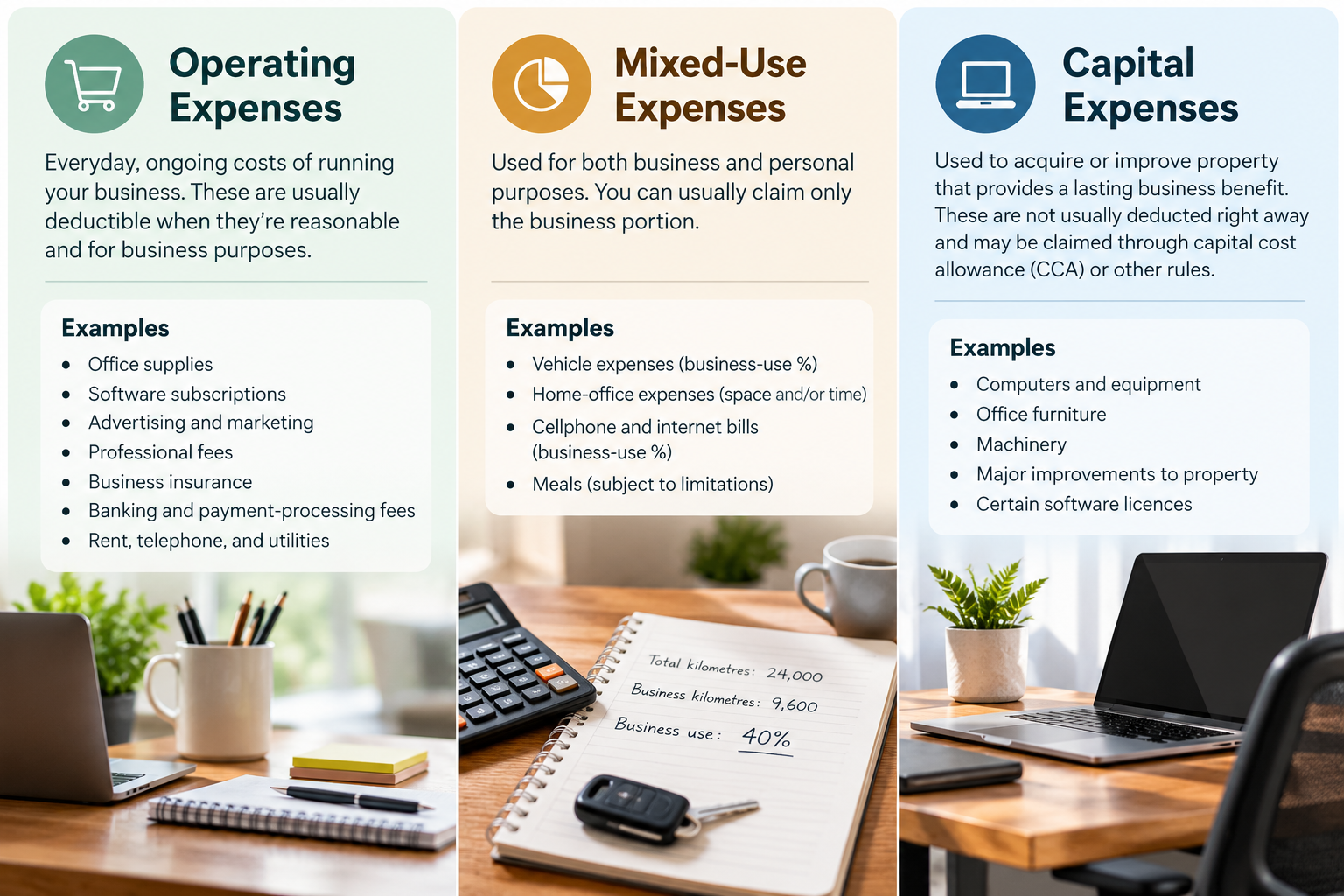
Operating expenses versus capital expenses
One of the most important distinctions in business taxation is whether a purchase is a current operating expense or a capital expense.
Operating expenses generally relate to the ordinary, ongoing costs of running a business.
Capital expenses generally involve acquiring or improving property that provides a lasting business benefit.
| Operating expense examples | Potential capital property examples |
|---|---|
| Routine stationery | Office furniture |
| Eligible monthly service subscriptions | Computers and equipment |
| Ordinary advertising costs | Machinery |
| Routine repairs | Major improvements to property |
These examples are illustrative, not automatic classifications. The correct treatment depends on the nature of the purchase and applicable tax rules.
Capital property may qualify for deductions through capital cost allowance (CCA) or other applicable provisions rather than an ordinary immediate expense deduction.
This is particularly important when purchasing expensive equipment.
How to handle expenses used for both business and personal purposes
Many self-employed people use the same resources for work and everyday life.
Examples include a cellphone, internet service, vehicle, or workspace.
The general approach is to identify and claim the eligible business portion rather than the entire cost.
A reasonable allocation method might rely on business kilometres compared with total vehicle kilometres, business use of a telephone or other shared service, or workspace area and, where applicable, time used for business.
The method should reflect how the item is actually used.
Avoid selecting arbitrary percentages simply because they produce a larger deduction.
What records should you keep for business expenses?
Good recordkeeping is one of the simplest ways to make tax preparation easier.
Ideally, each expense record should show:
Date: When the purchase occurred.
Vendor: Who supplied the product or service.
Description: What was purchased.
Amount: How much was charged.
Business purpose: Why the expense relates to your business.
Supporting document: The receipt, invoice, or other evidence.
Business-use calculation: When the purchase has a personal component.
For vehicle expenses, maintain a mileage log.
For a qualifying home workspace, keep your measurements and allocation calculations.
For purchases that may be capital property, retain records of the acquisition and related costs.
Why tracking expenses throughout the year matters
Waiting until tax season to organize business expenses creates unnecessary work.
Receipts can be misplaced, purchases become difficult to remember, and personal transactions may get mixed with business spending.
A consistent expense-tracking routine helps you identify potential deductions earlier, keep personal and business spending separate, maintain supporting documentation, understand how much operating your business actually costs, and prepare more organized financial information for tax filing.
The goal isn't simply to claim deductions. It's to maintain financial records that accurately reflect your business.
Where do you report business expenses on your tax return?
Self-employed individuals and sole proprietors generally use Form T2125, Statement of Business or Professional Activities, to report business or professional income and expenses as part of their personal income tax filing.
The form includes sections for reporting different expense categories and calculating business income.
If you need a walkthrough of the filing process, read our related guide:
How to File Self-Employment Taxes in Canada: A Step-by-Step Guide
Incorporated businesses generally have different tax-reporting requirements. The examples in this article primarily address common expenses for self-employed individuals and sole proprietors.
Frequently asked questions
Can I claim a business expense without a receipt?
You need adequate records to support your claim. Other documents may help establish a transaction if a receipt is missing, but a bank statement alone may not provide enough information. Unsupported claims can be disallowed.
Can I claim my internet bill if I work from home?
You may be able to claim an eligible business portion, depending on how the service is used and the applicable rules. You generally cannot claim an entire household bill merely because you sometimes work from home.
Can I claim coffee or lunch while working?
An ordinary personal meal is generally not deductible. Qualifying business meals may be deductible, usually subject to the general 50% limitation.
Can I claim expenses if my business hasn't earned revenue yet?
Some genuine business expenses may be incurred before your first sale. Whether they qualify depends on the circumstances, including when the business began operating, the purpose of the spending, and whether the cost is a current or capital expense.
Are software subscriptions tax-deductible in Canada?
Business-related software subscriptions may qualify as deductible expenses. The treatment depends on the nature of the software, the purchase arrangement, and whether it is used for business or personal purposes.
Can I claim the same expense for income tax and GST/HST purposes?
A purchase may be relevant to both calculations. However, if you claim a GST/HST input tax credit, you generally must reduce the corresponding income-tax expense amount by the credit claimed. This prevents the same tax amount from being deducted twice.
Final thoughts
Understanding business expense deductions doesn't mean trying to claim every purchase you make.
It means recognizing legitimate business costs, applying the appropriate rules, and keeping records that support your claims.
Whether you're managing a few recurring subscriptions or hundreds of transactions, building a reliable recordkeeping habit can make a meaningful difference.
When you know where your money goes, you can make better financial decisions throughout the year—not just when it's time to file your taxes.
Sources & References
- CRA — Business Expenses · Canada Revenue Agency (CRA)Accessed 2026-10-01
- CRA — Expenses Section of Form T2125 · Canada Revenue Agency (CRA)Accessed 2026-10-01
- CRA — Business-Use-of-Home Expenses · Canada Revenue Agency (CRA)Accessed 2026-10-02