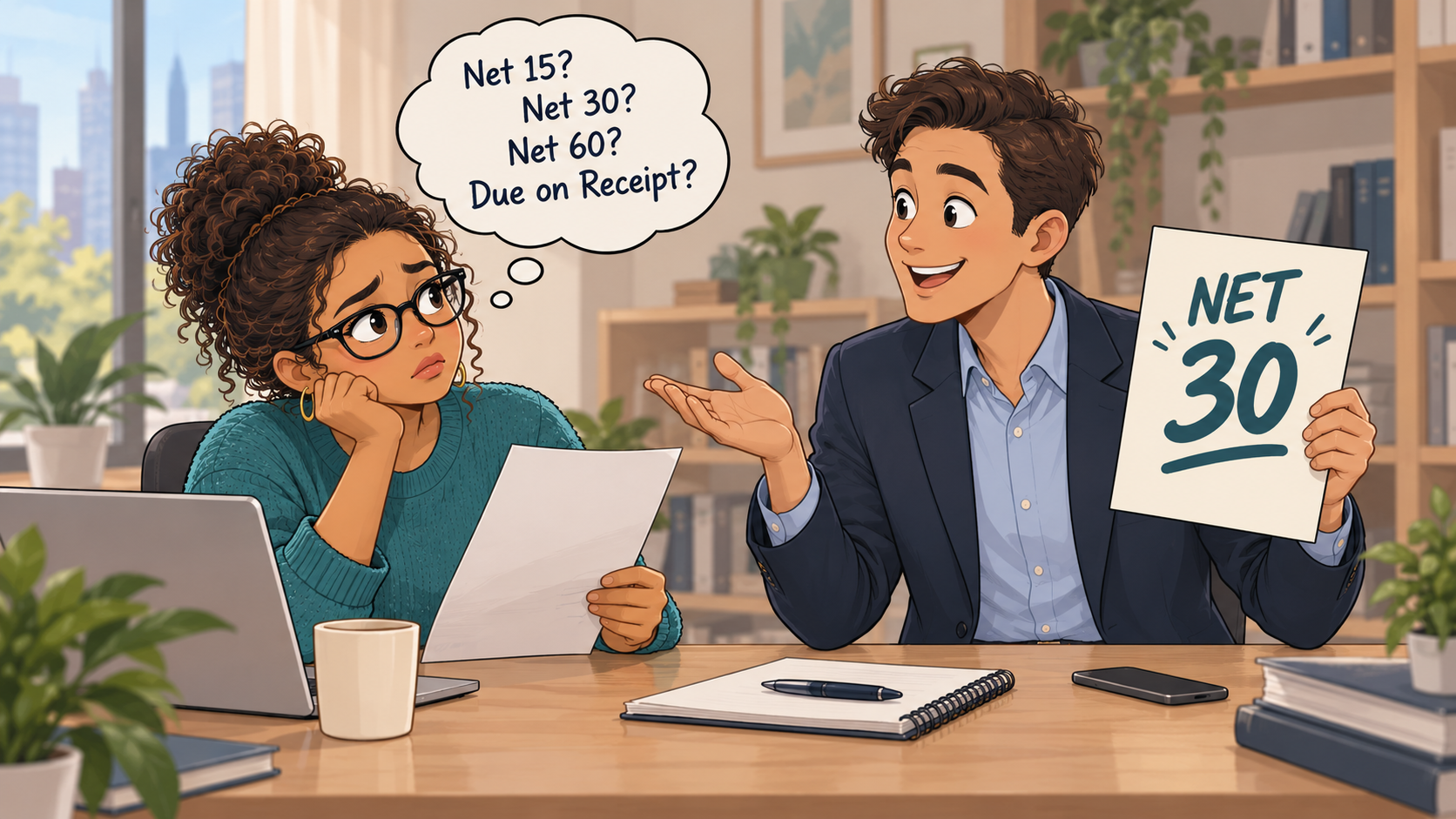
You've finished the work, sent the invoice, and now you're waiting for payment. But how long should you actually have to wait?
Seven days? Fifteen? Thirty?
And when a client asks for Net 30, are they requesting a reasonable payment window or an extra month to hold on to your money?
Invoice payment terms answer these questions. They establish when a customer must pay, how payment should be made, and what happens if the deadline passes.
Whether you're a freelancer billing for a project, a consultant working with corporate clients, or a small-business owner managing regular invoices, understanding payment terms can help you avoid awkward conversations and keep your cash flow predictable.
What Are Invoice Payment Terms?
Invoice payment terms are the conditions that explain when and how a customer is expected to pay for goods or services.
They may cover:
The payment deadline
Accepted payment methods
Whether a deposit or advance payment is required
Whether payment can be made in instalments
Any agreed early-payment discounts
Any applicable late-payment charges
Think of them as the ground rules for getting paid.
An invoice might say “Net 30,” but a customer may still wonder whether that means 30 days from the invoice date, the date they receive it, or the date the work was completed.
That's why good payment terms do more than use familiar abbreviations. They remove uncertainty.
What Does Net Mean on an Invoice?
In invoicing, “Net” generally means the full invoice balance is due within the stated payment period.
For example:
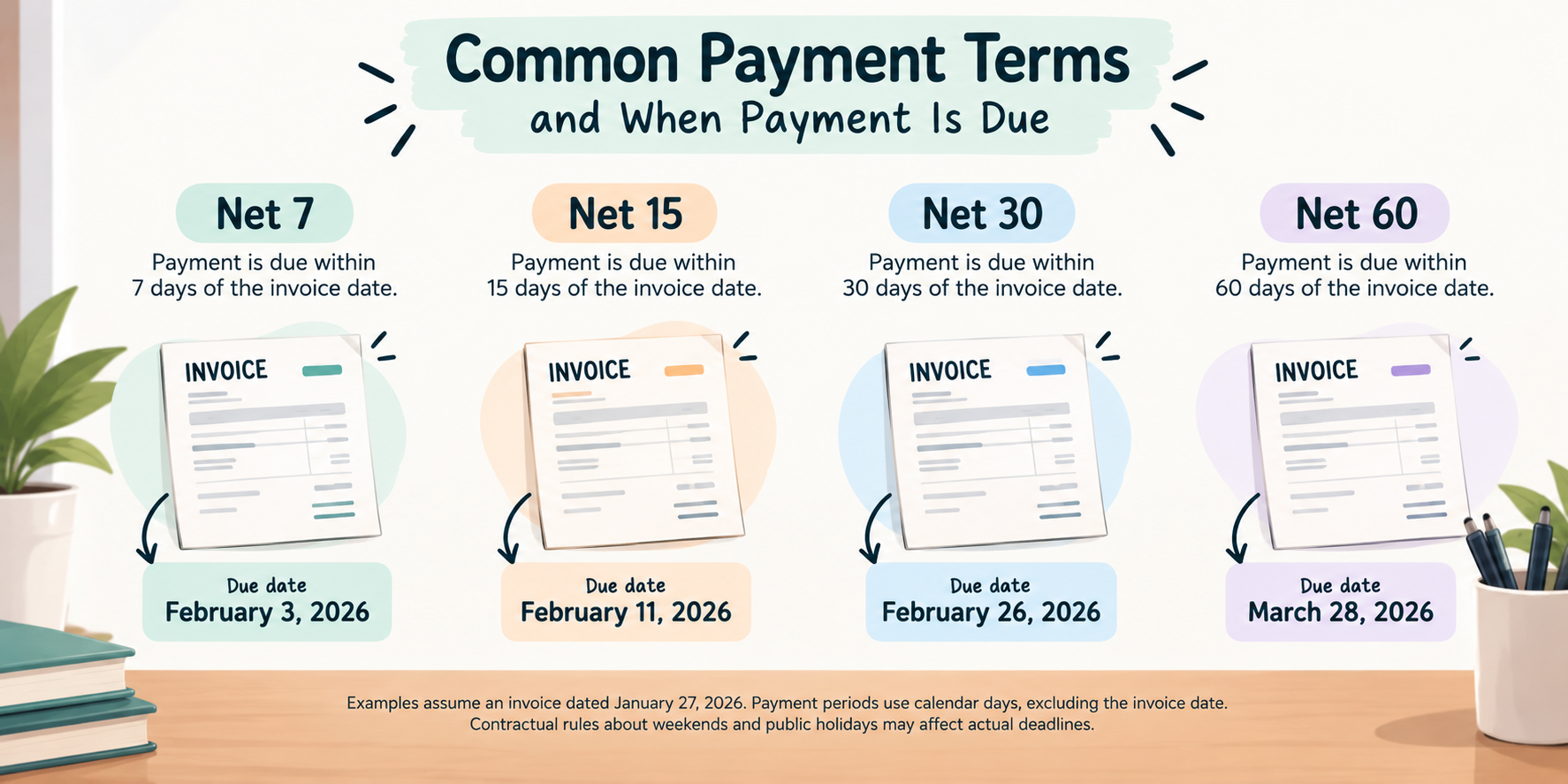
Net 7: Payment is due within 7 days.
Net 15: Payment is due within 15 days.
Net 30: Payment is due within 30 days.
Net 60: Payment is due within 60 days.
Net 90: Payment is due within 90 days.
The number indicates the payment period, not a discount or a tax rate.
In everyday invoicing, these periods generally refer to calendar days unless the agreement specifies business days. However, the starting event must also be clear.
A Net 30 agreement might begin on the invoice date, upon receipt of a valid invoice, or after acceptance of the work, depending on the contract.
Net 15 vs. Net 30 vs. Net 60: What's the Difference?
The biggest difference is how long your customer can wait before paying.
| Payment term | Meaning | Example due date |
|---|---|---|
| Net 7 | Full payment within 7 days | February 3, 2026 |
| Net 15 | Full payment within 15 days | February 11, 2026 |
| Net 30 | Full payment within 30 days | February 26, 2026 |
| Net 45 | Full payment within 45 days | March 13, 2026 |
| Net 60 | Full payment within 60 days | March 28, 2026 |
| Net 90 | Full payment within 90 days | April 27, 2026 |
All examples assume an invoice dated January 27, 2026. Payment periods use calendar days, excluding the invoice date. Contractual rules about weekends and public holidays may affect actual deadlines.
Net 7: A Short Wait
Net 7 gives customers one week to pay.
It can work for smaller projects, one-off services, or businesses that need faster cash flow. However, some larger clients may need more time to process invoices through their accounts payable departments.
Net 15: A Middle Ground
Net 15 gives customers approximately two weeks to pay.
It may suit freelancers, consultants, and service providers who want a reasonable payment window without waiting a full month.
Net 30: Common, but Not Compulsory
Net 30 gives customers approximately one month to pay.
It's familiar in business-to-business transactions, particularly where clients use formal invoice approval processes.
But here's something worth remembering: Net 30 isn't automatically the right choice for every small business.
A business paying its own bills every week may find that waiting 30 days for customer payments creates unnecessary pressure.
Net 60 and Net 90: Longer Credit Periods
These terms allow customers approximately two or three months to pay.
They may appear in larger commercial relationships, procurement arrangements, or contracts with established organizations.
Longer terms can make a deal attractive to a customer, but they also mean the supplier is effectively financing the gap between delivering the work and receiving payment.
Other Invoice Payment Terms You'll Encounter
Not every invoice uses a Net number.
Due on Receipt
“Due on receipt” means payment is expected when the customer receives the invoice.
It is commonly used when a business expects prompt payment rather than extending credit.
However, delivery and processing delays can still happen. For greater clarity, consider stating a specific date or explaining how immediate payment works under your agreement.
Payment in Advance
Payment in advance means the customer pays before goods are delivered or work begins.
This can be useful for custom orders, bookings, or projects that require significant upfront spending.
Deposit Required
A deposit is an agreed portion of the total price paid before work starts or reaches a specified stage.
For example, a designer might request a 30% deposit before beginning a project, with the balance payable later.
The contract should explain whether the deposit is refundable, when it is applied to the invoice, and when the remaining balance becomes due.
Milestone Payments
Milestone payments divide a project into stages.
A web designer, for example, might agree to:
30% before work begins
40% when the design is approved
30% when the project is delivered
This arrangement can reduce the amount of unpaid work outstanding at any one time.
End of Month (EOM)
EOM generally refers to the end of a month, but expressions such as “Net 30 EOM” can be interpreted differently depending on the agreement.
Don't assume the meaning. Define the calculation and display a specific due date.
2/10 Net 30
This term offers a 2% discount if the customer pays within 10 days. Otherwise, the full amount is due within 30 days.
For an invoice of $1,000 before any applicable tax considerations:
Payment within 10 days: $980
Payment after the discount period but within 30 days: $1,000
The exact discount basis and tax treatment should be established before using this arrangement.
Which Invoice Payment Terms Should You Choose?
There's no universal winner.
The right terms depend on your business, your expenses, your customer relationships, and how much time you can afford to wait for payment.
Consider Your Cash Flow
Start with a simple question:
Can your business comfortably wait this long to be paid?
If you need to pay contractors, buy materials, or cover operating expenses before your customer pays, long payment terms may create a cash-flow gap.
Shorter terms, deposits, or milestone payments may help.
Consider the Size of the Project
A $150 consultation and a $25,000 renovation project don't necessarily need the same billing arrangement.
For larger projects, collecting a deposit or invoicing at milestones can be more practical than waiting until everything is finished.
Consider Who You're Billing
Individual customers may be comfortable paying immediately or within a few days.
Larger companies may have invoice submission rules, purchase order requirements, and scheduled payment runs.
Ask about these requirements before agreeing to a deadline.
Consider the Relationship
You may be willing to offer longer terms to a long-standing customer with a dependable payment history.
For a new customer, a deposit or shorter payment period may be more appropriate.
Consider the Contract
Payment terms must also fit any applicable contract, industry rules, and local laws.
In some jurisdictions, commercial payment deadlines and late-payment rights are regulated. Don't assume a term is enforceable simply because it appears on your invoice.
How to Calculate an Invoice Due Date
Calculating a due date is straightforward once you've agreed on two things:
The starting date: When does the payment period begin?
The number of days: Are they calendar days or business days?
Suppose you issue an invoice on January 12, 2026, and agree to Net 30 from the invoice date.
Using calendar days and excluding the invoice date, the payment due date is February 11, 2026.
But if your contract says payment is due 30 days after the customer receives an approved invoice, and that happens on January 15, the due date would instead be February 14, 2026.
Both could be described informally as “30-day terms,” yet they produce different deadlines.
The safest approach is to put the agreed calculation in your contract and the resulting actual due date on the invoice.
How to Write Payment Terms on an Invoice
You don't need complicated legal language to communicate a payment deadline.
These examples show how straightforward the wording can be.
| Arrangement | Example wording |
|---|---|
| Net 15 | Payment due within 15 calendar days of the invoice date. Due: February 11, 2026. |
| Net 30 | Payment due within 30 calendar days of the invoice date. Due: February 26, 2026. |
| Due on receipt | Payment is due upon receipt of this invoice. |
| Deposit | A 30% deposit is due before work begins. The remaining balance is due upon project completion. |
| Milestones | Payment is due according to the milestones agreed in the project contract. |
The Net 15 and Net 30 examples assume an invoice dated January 27, 2026.
Where appropriate, also include accepted payment methods and the details your customer needs to pay you.
What Happens When an Invoice Becomes Overdue?
An invoice is generally overdue when the agreed payment deadline has passed and the required payment hasn't been received.
Before assuming the customer is refusing to pay, check whether:
The invoice reached the correct person.
The client needs a purchase order or other reference.
The payment is awaiting approval.
The client has raised a genuine dispute.
The payment has been initiated but hasn't cleared.
A professional reminder may be enough to resolve a simple oversight.
If the invoice remains unpaid, review your agreement and applicable law before adding interest, penalties, or collection costs.
Payment Terms Questions You Might Be Too Polite to Ask
Is Net 30 the same as 30 business days?
Usually, no. Net 30 commonly means 30 calendar days, but your agreement should specify how the period is calculated.
Does Net 30 start when I send the invoice?
Not necessarily. It may start on the invoice date, receipt date, or another agreed event. Check the contract.
Can I ask a customer to pay sooner than Net 30?
Yes, you can propose shorter terms, subject to the customer's agreement and any applicable rules. Agree on the deadline before issuing the invoice.
Is Net 15 better than Net 30?
Net 15 can improve the timing of cash receipts, but it may not suit every customer. The better option is the one your business can sustain and your customer can realistically meet.
Can I change payment terms for an existing client?
You can propose a change, but existing contractual obligations may require the client's agreement. A new invoice alone may not override earlier terms.
What does 2/10 Net 30 mean?
The customer can receive a 2% early-payment discount by paying within 10 days; otherwise, the full balance is due within 30 days, according to the agreed starting point and discount conditions.
Can I charge interest on overdue invoices?
Possibly. Your rights depend on the contract and applicable law. Some jurisdictions provide statutory late-payment rights, while others have different requirements or restrictions.
The Bottom Line: Clear Terms, Faster Payments
Payment terms aren't just tiny words at the bottom of an invoice. They determine how long your business may wait to receive money it has already earned.
Net 15 might work beautifully for a freelancer with short projects. Net 30 might suit a consultant billing established companies. A contractor managing an expensive project might be better served by deposits and milestone payments.
Whatever you choose, agree on the terms early, explain them plainly, and display the actual payment due date.
Because the only thing more frustrating than waiting for payment is discovering that you and your customer were counting from different dates.
Sources & References
- Determinants of Trade Credit Use by Small and Medium-Sized Enterprises in Canada · Innovation, Science and Economic Development CanadaAccessed 2026-01-19
- GST/HST in Special Cases · Canada Revenue AgencyAccessed 2026-01-16