If you're starting a business in Canada, you may have heard that you don't need to register for GST/HST until you earn $30,000.
That's a useful starting point, but it doesn't tell the whole story.
The registration rules depend on the type of business you operate, what you sell, how much taxable revenue you earn, and when you cross the applicable threshold.
And there's another important detail: GST/HST registration is different from registering your business name or incorporating a company.
Whether you're a freelancer sending your first invoices, a consultant growing your client base, or a small-business owner selling products, this guide will help you understand when registration is necessary and what to do next.
What is GST/HST registration?
GST stands for Goods and Services Tax, while HST stands for Harmonized Sales Tax.
These are taxes that apply to many goods and services sold in Canada.
A GST/HST account is a program account administered by the Canada Revenue Agency (CRA). Registration allows a business to charge and collect the applicable GST/HST on taxable supplies and creates responsibilities for reporting and remitting the tax.
The tax charged depends on the applicable rules, including the type of supply and its place of supply.
Registration doesn't mean that every sale you make will have GST/HST added to it. Some supplies are zero-rated, while others are exempt.
Does every business in Canada need to register for GST/HST?
No.
Many small businesses qualify as small suppliers and aren't required to register immediately.
For most businesses, the general small supplier threshold is $30,000 in revenue from taxable supplies over the relevant period.
However, certain businesses must register even if they remain below that threshold. Special rules also apply to some organizations and business activities.
The threshold is based on qualifying revenue, not profit.
For example, spending $15,000 on business expenses doesn't reduce $35,000 of qualifying sales to $20,000 for purposes of the small supplier threshold.
What counts toward the $30,000 threshold?
For most businesses, the calculation generally includes revenue from taxable supplies, including zero-rated supplies, made worldwide by the business and its associates.
Certain amounts are excluded, including proceeds from sales of capital property, supplies of financial services, and goodwill from the sale of a business.
The rules also require consideration of associated businesses where applicable.
This means you shouldn't automatically use the revenue shown in a single bank account or subtract expenses to determine whether you've crossed the threshold.
Understanding the four-calendar-quarter rule
One of the most common misunderstandings is that the GST/HST threshold resets every January.
For most businesses, it doesn't work that way.
The CRA looks at a single calendar quarter and at four consecutive calendar quarters.
The calendar quarters are:
Quarter
Months
Q1
January–March
Q2
April–June
Q3
July–September
Q4
October–December
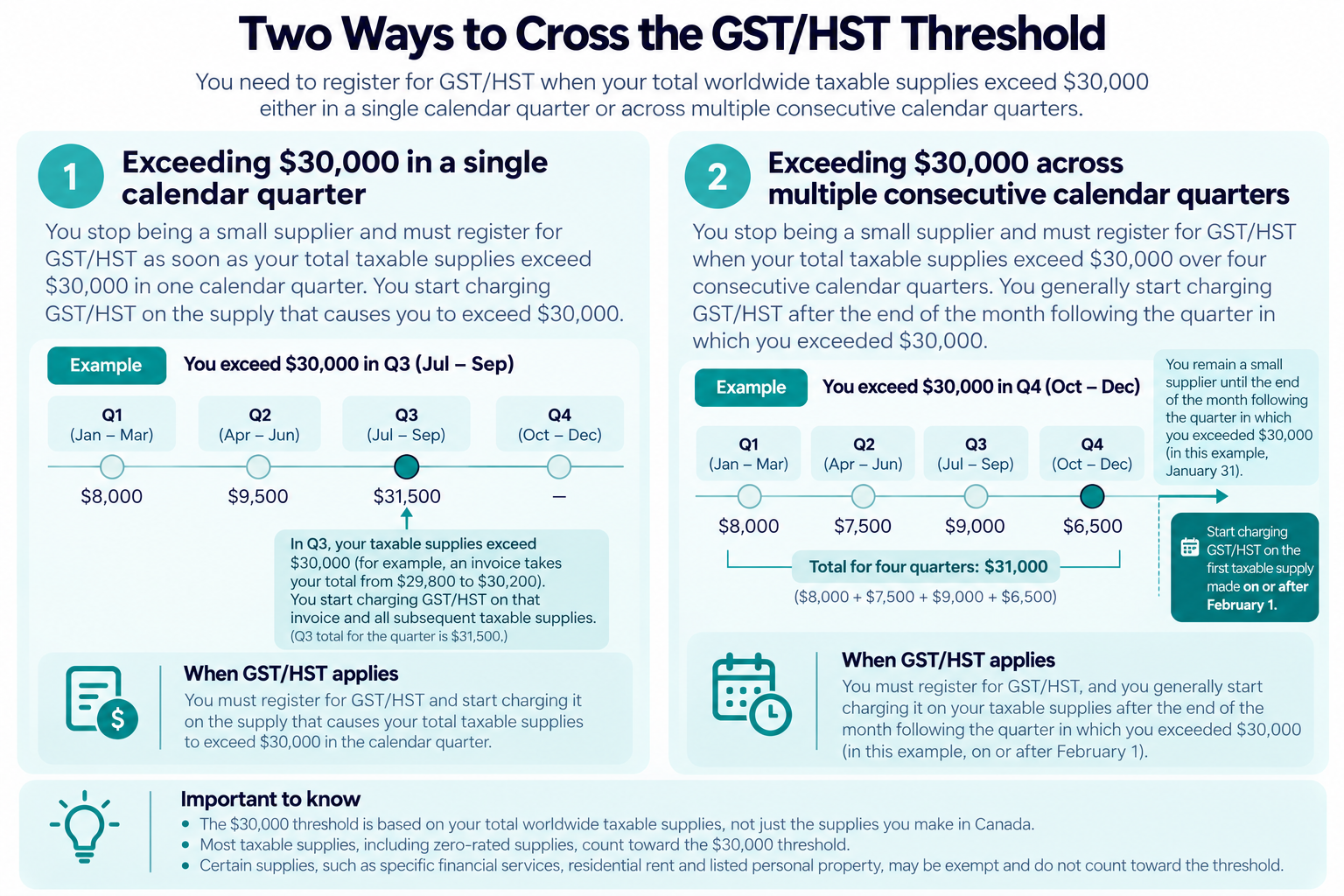
The timing of registration depends on how your business exceeds the threshold.
Scenario 1: You exceed $30,000 in one calendar quarter
Suppose a small consulting business earns $34,000 in qualifying revenue between January and March.
Because the business exceeded the threshold within a single calendar quarter, it generally stops being a small supplier on the supply that pushed it over $30,000.
It must begin charging GST/HST on that supply, not simply on the next invoice.
The business must also register within the applicable CRA registration period.
Scenario 2: You exceed $30,000 across several calendar quarters
Now imagine a different business with these qualifying sales:
Calendar quarter
Revenue
Q1
$8,000
Q2
$9,000
Q3
$7,000
Q4
$9,000
Total
$33,000
The business has exceeded $30,000 over four consecutive quarters, but not in any single quarter.
In this situation, the business generally remains a small supplier until the end of the month following the quarter in which it exceeded the threshold.
GST/HST registration and charging obligations then arise under the applicable effective-date rules.
For example, if the relevant quarter ends on December 31, the following month is January. The business generally stops being a small supplier at the end of January and must begin charging GST/HST on its first taxable supply after that point.
The exact registration deadline follows the effective date determined under CRA rules.
How businesses cross the $30,000 GST/HST threshold affects when they must register and begin charging GST/HST
Can you register for GST/HST before reaching $30,000?
Yes. Many businesses can register voluntarily while they still qualify as small suppliers.
This may be worth considering if you regularly purchase goods or services for your business and want to claim eligible input tax credits.
An input tax credit (ITC) may allow a registered business to recover GST/HST paid or payable on eligible purchases used in its commercial activities.
However, voluntary registration also creates obligations.
Once registered, you generally must charge applicable GST/HST, file returns, and remit the amounts owing, even if your sales remain below the small supplier threshold.
You may also have to remain registered for at least one year before cancelling, unless an applicable exception applies.
Input tax credits and income tax deductions are different, even when they relate to the same purchase. For a closer look at expenses that may qualify for income tax deductions, read our guide to business expenses you can claim on your taxes in Canada.
When might voluntary registration make sense?
Consider a freelance designer who purchases business equipment, software, and professional services.
Registering voluntarily may allow the designer to claim eligible ITCs on qualifying business purchases.
But the designer will also need to manage GST/HST on taxable sales and complete the required reporting.
The right decision depends on the business's circumstances, including its customers, expenses, administrative capacity, and type of supplies.
Businesses that may need to register regardless of revenue
The ordinary small supplier threshold doesn't apply in the same way to every business.
For example, taxi operators and commercial ride-sharing drivers generally must register for GST/HST in connection with their taxable passenger transportation services, even if their revenue is below $30,000.
There are also special rules for certain non-resident businesses and other activities.
Charities and public service bodies can be subject to different small supplier tests.
If your business falls into a special category, don't rely solely on the general $30,000 rule.
How to register for GST/HST in Canada
The CRA provides an online registration process for business numbers and GST/HST program accounts.
Here's how to prepare.
Step 1: Determine whether registration is required or voluntary
Review your business activities and qualifying revenue.
If you've exceeded the small supplier threshold, determine whether it happened in one quarter or across multiple quarters.
This helps establish when your registration should take effect.
Step 2: Gather your business information
Have the relevant business details available, including your legal business name, business structure, contact information, business activities, and registration effective date.
The CRA may also request information about your fiscal year and expected taxable sales.
Preparing these details beforehand makes the process easier.
Step 3: Access CRA Business Registration Online
Use the CRA's official GST/HST registration page to begin.
Follow the current CRA instructions to access Business Registration Online through your CRA account.
If you already have a business number, you can use it to add the GST/HST program account.
If you don't have a business number, the registration process can provide one.
Step 4: Enter your GST/HST registration information
Follow the prompts to provide your business details and registration information.
Pay particular attention to the effective date.
If you were required to register earlier, don't simply choose today's date without considering when your obligation actually began.
The CRA has a separate process for requesting a registration date more than 30 days in the past.
Step 5: Save your registration details
Once registration is completed, save the business number and GST/HST account number provided during the process.
You'll need these details for future tax administration and business records.
What happens after you register?
Registration is only the beginning.
Once you have a GST/HST account, you need a reliable way to manage the tax you collect and your reporting obligations.
Charge the correct tax
Apply GST/HST to taxable supplies according to the relevant rules.
Don't assume that every customer or transaction uses the same rate.
Keep GST/HST records separate
Your records should make it possible to identify:
Sales before GST/HST.
GST/HST charged to customers.
Eligible GST/HST paid on business purchases.
Relevant adjustments.
Amounts reported and remitted.
Separating the tax from ordinary business revenue helps you avoid treating collected GST/HST as money available for everyday spending.
Understand your filing obligations
Registered businesses generally need to file GST/HST returns for their assigned reporting periods, including periods with no business activity when a return is required.
Your reporting period and deadlines depend on your circumstances.
This guide focuses on registration. The details of preparing and filing GST/HST returns deserve their own explanation.
GST/HST returns are separate from your annual income tax return. If you're self-employed, our guide to filing self-employment taxes in Canada explains how to report your business income and expenses for income tax purposes.
Review your invoices
Your invoices and receipts may need to show prescribed information, including relevant GST/HST details, depending on the transaction.
Accurate invoicing makes it easier for customers to understand charges and, where eligible, support their own ITC claims.
Common GST/HST registration mistakes
Assuming the threshold is based on profit
The general small supplier threshold is based on qualifying revenue, not revenue minus expenses.
Waiting until the end of the year
GST/HST registration isn't determined solely by annual revenue. A single calendar quarter can trigger an obligation.
Forgetting about voluntary registration responsibilities
Registering voluntarily may provide access to eligible ITCs, but it also means taking on GST/HST reporting and collection obligations.
Assuming every sale is taxable at the same rate
Tax treatment varies. Some supplies are zero-rated or exempt, and the applicable rate for taxable supplies depends on the relevant rules.
Mixing collected GST/HST with operating income
GST/HST collected from customers may need to be remitted to the CRA. Treating it as ordinary business revenue can make cash-flow management difficult.
GST/HST Registration: What You Need to Know
Do I need a GST/HST number if my business earns less than $30,000?
Many businesses below the general small supplier threshold don't need to register. However, some activities have special mandatory registration rules, and eligible businesses may choose voluntary registration.
Is the $30,000 GST/HST threshold based on profit or revenue?
It's generally based on qualifying revenue from taxable supplies before expenses, subject to the CRA's calculation rules.
Does the $30,000 threshold reset every January?
No. For most businesses, the calculation considers a single calendar quarter and four consecutive calendar quarters.
Can I register for GST/HST before making my first sale?
Voluntary registration may be possible where you are engaged in commercial activity and meet the applicable conditions. The CRA determines the effective date under its registration rules.
Can I charge GST/HST without registering?
A small supplier that isn't registered generally doesn't charge GST/HST on ordinary taxable supplies, subject to specific exceptions. If registration becomes mandatory, charging obligations can arise from the effective date even if the administrative registration process hasn't been completed.
Is a business number the same as a GST/HST number?
No. A business number identifies the business within the CRA's system, while a GST/HST program account identifies its GST/HST registration.
Do I need to register if I only provide exempt services?
Businesses making only exempt supplies generally cannot register for GST/HST under the ordinary voluntary registration rules. The treatment depends on the nature of the supplies and any applicable exceptions.
Final thoughts
GST/HST registration is an important milestone, but it doesn't have to be confusing.
Start by understanding whether your business qualifies as a small supplier. Track your qualifying revenue across calendar quarters, pay attention to when the threshold is exceeded, and determine whether voluntary registration makes sense for your business.
Once registered, focus on keeping accurate sales, tax, and expense records.
A clear system for managing those records can make GST/HST administration far less stressful as your business grows.