
Your business has just had a fantastic month.
Sales are up. Customers are placing orders. Your accountant tells you the business made a profit.
Then you check your bank account.
Suddenly, you're wondering how you'll pay next week's bills.
Wait a minute. If the business is profitable, where did all the money go?
This is one of the most confusing parts of running a business, especially when you're starting out. The answer comes down to two financial concepts that sound similar but tell very different stories: profit and cash flow.
Understanding both can help you make better spending decisions, prepare for upcoming bills, and avoid the unpleasant surprise of being profitable on paper but short of money in the bank.
Cash Flow vs. Profit: What's the Difference?
Let's start with the simplest explanation.
Profit tells you whether your business is earning more than it costs to operate.
Cash flow tells you how money actually moves into and out of your business.
They're connected, but they don't always happen at the same time.
Imagine you complete a project for a customer in February and send an invoice for $5,000.
Under accrual accounting, you may recognize that $5,000 as revenue when it is earned, even if your customer won't pay until March.
The sale can contribute to February's profit.
But until the customer pays, it hasn't increased the cash in your bank account.
That's the difference in action.
What Is Profit?
Profit is the amount remaining after subtracting the expenses recognized for a period from the revenue recognized for that period.
In simple terms:
Profit = Revenue − Expenses
Suppose your business earns $10,000 in revenue and incurs $7,000 in expenses.
Your profit is $3,000.
But that doesn't necessarily mean you received $10,000 in cash or paid exactly $7,000 during that period.
The timing depends partly on your accounting method.
Under accrual accounting, revenue and expenses are generally recorded when earned or incurred, rather than solely when money changes hands.
Under cash-basis accounting, timing works differently. Even then, profit and available cash can differ because of items such as loan proceeds, repayments, asset purchases, and owner withdrawals.
What Is Cash Flow?
Cash flow tracks money received and money paid during a period.
For a simple cash movement calculation:
Net Cash Flow = Cash Received − Cash Paid
If your business receives $8,000 and pays out $6,500 during a month, its net cash flow is positive $1,500.
If it receives $8,000 but pays out $10,000, its net cash flow is negative $2,000.
You also need to consider the cash you already had.
A business with $15,000 in the bank can survive a $2,000 negative cash-flow month more easily than a business starting with only $500.
Profit and Cash Flow Side by Side
Here's a quick comparison.
| Profit | Cash flow |
|---|---|
| Measures financial performance | Measures movement of cash |
| Focuses on revenue and expenses | Focuses on actual cash receipts and payments |
| Reported on an income statement | Reported on a cash flow statement |
| May include unpaid customer invoices under accrual accounting | Includes customer payments when cash is actually received |
| May include non-cash expenses such as depreciation | Reflects actual cash movements, including certain asset purchases and loan transactions |
| Helps assess whether a business is financially sustainable | Helps assess whether a business can meet upcoming cash obligations |
Neither is more important in every situation.
A business needs sufficient profitability over time, but it also needs enough cash at the right moments to keep operating.
How Can a Business Make $5,000 in Profit and Still Run Short of Cash?
Meet Maya, the fictional owner of a small design studio.
February 2026 has been a good month for her business.
She's completed several projects, invoiced her customers, and kept her operating costs under control.
On paper, the results look encouraging.
What Her Income Statement Shows
During February:
| Item | Amount |
|---|---|
| Revenue earned | $16,000 |
| Operating expenses incurred | ($11,000) |
| Profit before tax | $5,000 |
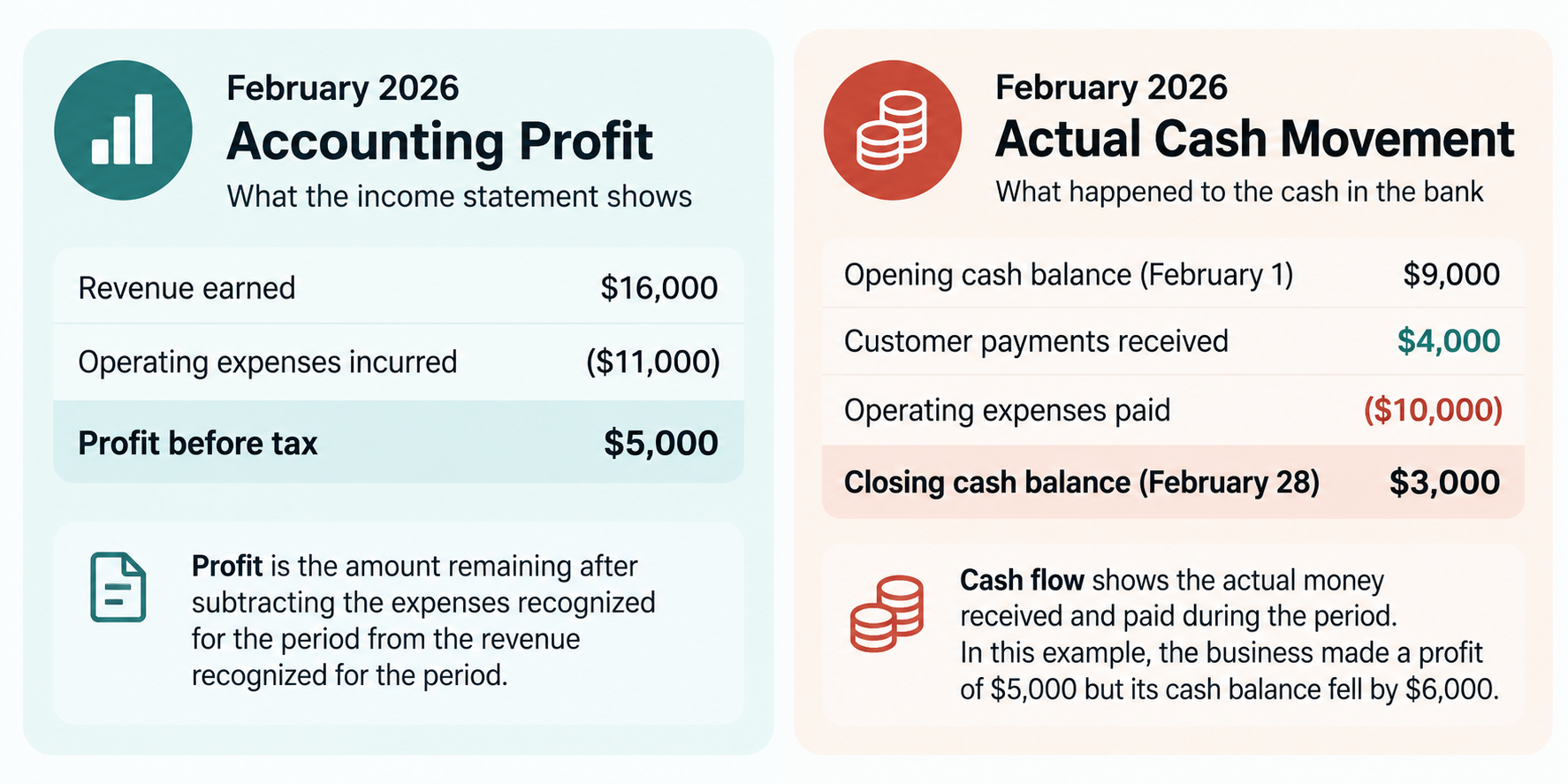
Maya's studio earned $5,000 in accounting profit before tax.
So far, so good.
But there's something the income statement doesn't tell us: when the money was received and paid.
What Actually Happened to Her Cash
At the beginning of February, Maya had $9,000 in her business bank account.
Of the $16,000 in revenue earned during February, customers paid only $4,000 before the month ended.
The remaining $12,000 was still owed to the studio.
Meanwhile, Maya paid $10,000 of the month's operating expenses in cash. Another $1,000 of expenses remained unpaid.
Here's what happened:
| Cash movement | Amount |
|---|---|
| Opening cash balance, February 1 | $9,000 |
| Customer payments received | +$4,000 |
| Operating expenses paid | −$10,000 |
| Closing cash balance, February 28 | $3,000 |
The studio made $5,000 in profit, but its cash balance fell by $6,000.
And both figures are correct.
For clarity, this simplified example excludes income taxes, financing, capital purchases, and other transactions. It assumes no opening customer or supplier balances affect the month's figures.
Where Did the Difference Go?
We can reconcile the two figures.
| Reconciliation | Amount |
|---|---|
| February accounting profit | $5,000 |
| Less: Revenue earned but not yet collected | −$12,000 |
| Add: Expenses incurred but not yet paid | +$1,000 |
| February net cash movement | −$6,000 |
The mathematics works:
$5,000 − $12,000 + $1,000 = −$6,000
Maya didn't lose the entire $12,000 in unpaid customer invoices. Those amounts are still recorded as money customers owe her.
But she can't use an unpaid invoice to pay an employee.
Now imagine that $4,000 in payroll is due on March 4 and no additional customer payments arrive before then.
With only $3,000 available, Maya would be $1,000 short.
Her business is profitable, yet she has an immediate cash problem.
That's why a healthy-looking profit figure isn't enough to tell you whether your business can afford its next payment.
Five Reasons Profitable Businesses Run Into Cash Problems
Maya's situation isn't unusual in principle. Several everyday business activities can cause profit and cash to move in different directions.
1. Customers Haven't Paid Their Invoices
This is one of the most straightforward causes.
You deliver the work and recognize the revenue, but your customer is allowed to pay later.
Meanwhile, rent, salaries, software subscriptions, and other payments continue.
Money owed to your business by customers is called accounts receivable.
An unpaid invoice may represent a legitimate sale, but it won't solve an immediate cash shortage.
Clear invoice payment terms, prompt invoicing, and consistent follow-up can help reduce the waiting period.
2. Inventory Uses Cash Before It Generates Sales
Suppose you run a small retail store.
You spend $8,000 buying products for the upcoming season.
Your bank balance drops when you pay the supplier.
But if the products remain unsold, their cost generally isn't treated as the cost of goods sold on the income statement yet. Instead, the unsold inventory is normally carried as an asset.
So your cash decreases before the purchase has its full effect on profit.
If stock stays on shelves longer than expected, that cash remains tied up in inventory.
This is why strong sales forecasts and sensible inventory purchasing matter.
3. Equipment Purchases Can Reduce Cash Immediately
Imagine your business purchases a new machine for $6,000 in cash.
Your bank balance falls by $6,000.
But if the machine is a capital asset, the full purchase cost generally isn't recognized as an ordinary operating expense all at once.
Depending on the applicable accounting rules, the asset's cost may instead be recognized through depreciation over time.
That means the immediate cash outflow can be much larger than the expense appearing on the income statement for that period.
4. Loan Repayments Need Cash
A business loan can create a timing difference in the opposite direction.
When you receive loan proceeds, your cash increases, but the borrowed amount isn't ordinarily sales revenue or profit.
When you repay the loan, the principal payment reduces cash and the outstanding debt. It generally isn't an income-statement expense.
Interest is treated differently and is generally an expense.
If you look only at profit, you may overlook how much cash your debt repayments require.
5. A Growing Business May Need More Cash
Growth sounds like it should make financial life easier.
Sometimes it does. But growth can also increase the amount of money you need upfront.
More customer orders may mean buying additional inventory, hiring staff, paying suppliers, or delivering larger projects before customers pay.
In other words, your business may need more cash precisely because it's becoming more successful.
That's why growth plans should include forecasts for both profitability and cash requirements.
Can You Have Positive Cash Flow but Still Lose Money?
Yes. And this is where things get interesting.
Imagine a business reports an accounting loss of $2,000 for the month.
During that same month, it receives a $20,000 bank loan.
The loan increases its cash balance, even though the business hasn't earned an additional $20,000 in revenue.
Likewise, an owner contributing money to a business can improve available cash without creating operating profit.
So positive cash flow doesn't necessarily mean your business is profitable.
It's worth asking where the money came from.
Cash generated by regular customer sales is different from cash received through borrowing or owner investment.
Both may be useful, but they tell different stories about the business.
The Three Types of Cash Flow
A formal cash flow statement generally groups cash movements into three categories.
Operating Cash Flow
This covers cash related to the business's main operating activities.
Examples include payments received from customers and cash paid to suppliers and employees.
Healthy operating cash flow is particularly useful because it helps show whether normal business activities are generating cash.
Investing Cash Flow
This generally covers cash used to acquire or received from disposing of long-term assets and certain investments.
Purchasing equipment is a common example of an investing cash outflow.
Financing Cash Flow
This covers cash movements related to financing the business.
Examples include receiving a loan, repaying loan principal, and receiving capital contributions from owners.
These categories explain why total cash movement alone doesn't tell the entire financial story.
A business might have positive overall cash flow because it borrowed money, even while its day-to-day operations are consuming cash.
The exact classification of some transactions depends on the applicable accounting framework and accounting policies.
Working Capital: The Money Between Paying and Getting Paid
There's another financial concept worth understanding: working capital.
Working capital is generally calculated as:
Working Capital = Current Assets − Current Liabilities
Current assets can include cash, accounts receivable, and inventory.
Current liabilities can include amounts owed to suppliers and other obligations due in the short term.
Working capital helps assess a business's ability to meet near-term obligations.
But it's not the same thing as cash in the bank.
For example, a business might have significant working capital because it owns a large amount of inventory and has many unpaid customer invoices.
That doesn't necessarily mean it has enough cash for tomorrow's payroll.
How quickly inventory sells, customers pay, and supplier bills become due matters just as much as the totals.
How to Keep Profit From Fooling You
You don't need a finance degree to start managing cash flow more deliberately.
A few habits can make a significant difference.
Look at Profit and Cash Together
Review your profit and loss statement alongside your bank balance and, where available, a cash flow statement.
Your profit and loss statement answers:
Are we earning more than the costs recognized for this period?
Your cash flow information answers:
Is enough money actually coming in to cover what needs to be paid?
You need both perspectives.
Know Which Customers Still Owe You
Keep an up-to-date list of outstanding invoices.
For each invoice, record the customer, amount, due date, and payment status.
This makes it easier to see how much of your reported revenue hasn't turned into cash.
It also helps you identify overdue accounts before they become bigger problems.
Plan for Bills Before They're Due
List your expected outgoing payments, including payroll, rent, supplier bills, taxes, debt repayments, and planned equipment purchases.
Knowing the total isn't enough.
You also need to know when each payment is due.
A bill due tomorrow matters differently from one due in six weeks.
Build a Simple Cash Flow Forecast
A cash flow forecast estimates how much money will come in and go out over an upcoming period.
You can start with a weekly forecast.
Here's a simple example for a fictional business.
| Forecast | Mar. 2–8 | Mar. 9–15 | Mar. 16–22 |
|---|---|---|---|
| Opening cash | $3,000 | $1,500 | $3,000 |
| Expected customer receipts | $2,500 | $4,000 | $3,500 |
| Planned cash payments | ($4,000) | ($2,500) | ($3,000) |
| Forecast closing cash | $1,500 | $3,000 | $3,500 |
Illustrative amounts only. Each week's closing balance becomes the following week's opening balance. Inflows and outflows are grouped by week, so the forecast doesn't reveal possible shortages on individual days.
The forecast tells you what you expect to happen. It isn't a guarantee.
Customers may pay late. A repair may cost more than expected. An unexpected bill may appear.
That's why forecasts work best when they're reviewed and updated regularly.
Keep Some Cash Available for Surprises
An unexpected repair or delayed customer payment can put pressure on a business with little cash available.
Where possible, build a reserve based on your business's recurring expenses, seasonal patterns, and financial risks.
There isn't one reserve amount that works for every business.
Start by understanding your essential upcoming payments and how predictable your customer receipts are.
Don't Confuse a Big Bank Balance With a Big Profit
This mistake works both ways.
An unusually high bank balance may include loan proceeds, customer deposits, or money needed for upcoming taxes and other obligations.
Not all the money in the account is necessarily free to spend.
Before making a major financial decision, check what the cash represents and what obligations remain.
Which Numbers Should You Watch Regularly?
You don't need to track dozens of financial metrics immediately.
For many small businesses, these five are a practical starting point:
| Metric | What it helps you understand |
|---|---|
| Net profit | Whether the business earned more revenue than the expenses recognized |
| Cash balance | How much cash is currently available |
| Accounts receivable | How much customers still owe you |
| Accounts payable | How much you owe suppliers |
| Forecast cash balance | Whether you expect enough cash to meet upcoming payments |
Together, these numbers give you a more useful picture than sales or profit alone.
If you're already keeping organized financial records, this becomes much easier. A consistent bookkeeping routine helps you see how invoices, expenses, payments, and bank transactions fit together.
The Number That Keeps the Lights On
Profit matters. A business can't ignore whether it's earning enough to cover its costs over time.
But profit doesn't pay an invoice. Cash does.
A strong month of sales can still leave you struggling if customers haven't paid, inventory has absorbed your money, or major bills are due before the next payment arrives.
The goal isn't to choose between profitability and cash flow.
It's to understand both, pay attention to timing, and make sure your business can meet its obligations while working toward long-term financial health.
Because a profitable business should be more than a good-looking income statement. It should also have a plan for keeping the lights on.
Sources & References
- 5 tips to manage your cash flow · Business Development Bank of Canada (BDC)Accessed 2026-02-18
- Techniques for better cash flow management · Business Development Bank of Canada (BDC)Accessed 2026-02-18
- How to manage working capital in a growing business · Business Development Bank of Canada (BDC)Accessed 2026-02-19